

Banks built the housing credit market. They supply about 80 percent of the equity, the biggest single source on a 9 percent deal.
In my career, every lever in a deal has spiked at some point: interest rates, construction costs, insurance. Equity price is a lever too, and it moves up and down. Sometimes the banks have the advantage and sometimes developers regain some ground. Right now the banks have it. Banks, profit and CRA are why all we hear about today is economic investment, cents on the dollar and return. That now matters to the group that supplies about 80 percent of the equity.
What Banks Earned
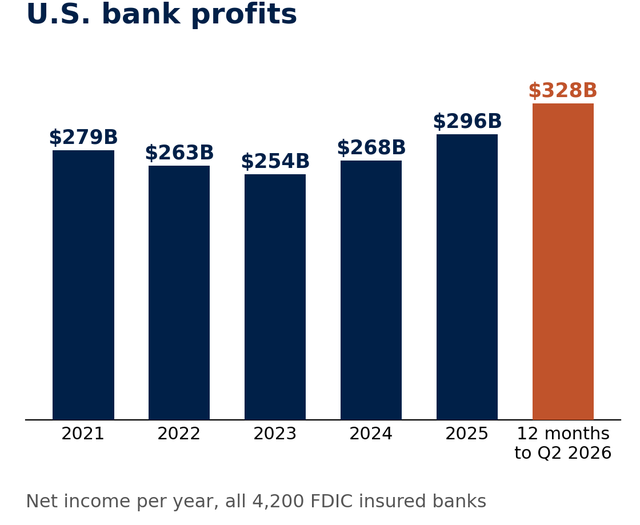
Net income per year, all 4,200 FDIC insured banks. Source: FDIC.
- $254 billion in 2023, about $328 billion over the 12 months to the second quarter of 2026. That is $73 billion a year higher, up 29 percent.
- Not 2026 alone. The gain came in steps: $14 billion in 2024, $27 billion in 2025 and $32 billion in the last 12 months.
- The second quarter of 2026 alone: $90.1 billion, up 28.7 percent from a year earlier.
- The big housing credit buyers match: net income up 20 percent at U.S. Bancorp, 27 at Bank of America, 17 at Wells Fargo and 13 at JPMorgan, excluding one time items.
Profits vs. CRA Investment
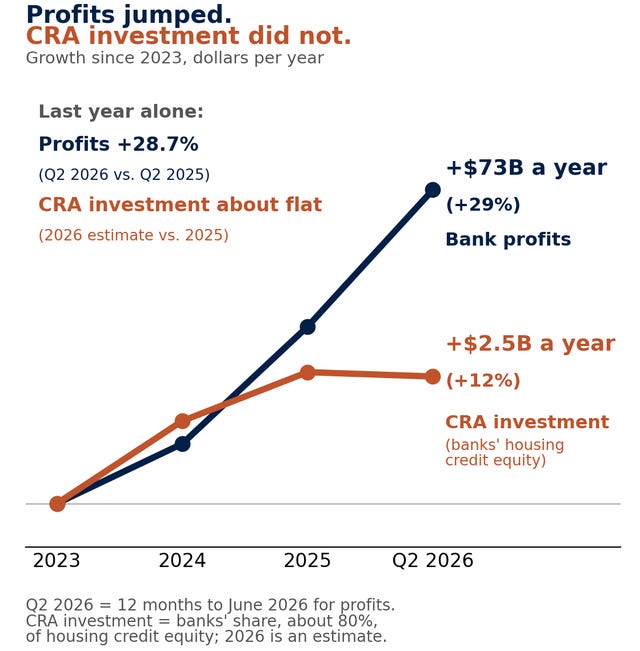
Sources: FDIC; CohnReznick; Apers; Enterprise estimate for 2026.
- CRA is the Community Reinvestment Act. It is why banks buy most housing credits: exam credit in return for a lower return.
- CRA investment is banks’ housing credit equity: about $21.5 billion in 2023 and about $24 billion in 2026, an estimate. That is $2.5 billion a year more, against $73 billion more in profit.
- In the last year alone, profits rose 28.7 percent and CRA investment was about flat.
- Why flat? What I hear from banks is basic supply and demand: more credits for sale, lower price. A bank can invest for CRA credit at a lower return, or purely for the economic return, which adds to its profit.
- I do not know which is driving it. It could be the CRA incentive, capital rules, tax capacity, underwriting staff or the economic return. The 2026 number is an estimate because the year is not over.
- The CRA proposal open for comment through October 13 would loosen the incentive for about 800 banks, by NCRC’s count.
Cents on the Dollar
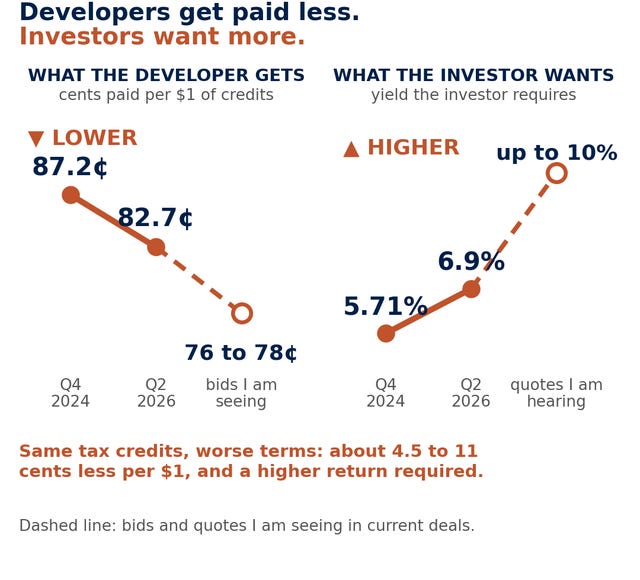
Source: Affordable Housing Finance surveys, Q4 2024 and Q2 2026 (22 syndicators). Dashed lines are bids and quotes I am seeing.
- Price: 87.2 cents in Q4 2024, 82.7 in Q2 2026. The bids I see are 76 to 78.
- Yield investors require: 5.71 percent, then 6.9. Quotes I hear go up to 10.
- Interest rates, construction costs and insurance moved too. A developer sets none of them.
What It Costs Housing Policy
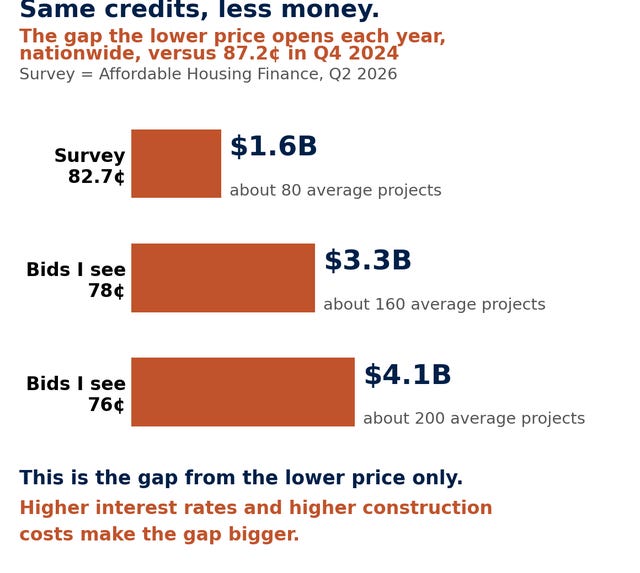
Source: author arithmetic from the surveys above and an Enterprise estimate of $30 billion of equity. A project is $20.6 million of equity, the survey average.
- The promise: the 2025 law is expected to finance 1.2 million more homes over a decade, per Novogradac. The coalition that fought for it said it would take significantly more private sector investment.
- The gap: same credits, less money. The lower price opens a gap of $1.6 billion to $4.1 billion a year nationwide, the equity of roughly 80 to 200 average projects. Higher interest rates and construction costs make it bigger.
- Slower: each added funding source adds about four months and $20,460 per home, found Berkeley’s Terner Center in California.
- Fewer: a small drop in price can make a few properties infeasible, says Novogradac’s Peter Lawrence.
- Smaller developers and nonprofits first: syndicators describe a flight to quality, strong sponsors and bigger deals. The groups that exist to meet housing policy needs wait.
The Word From the People Providing the Juice
- Walker & Dunlop’s Jennifer Erixon: investor capital has not grown at the pace of the volume, and smaller deals are struggling.
- U.S. Bancorp Impact Finance’s Kyle Kochtanek: at 75 cents it becomes increasingly difficult for deals to pencil.
- PNC Multifamily Capital’s John Nunnery: deals are hard to close without state and local money.
Willy Walker, Walker & Dunlop’s CEO, described his firm as a leader in “lending, sales, and tax credit syndication.” The equity price decides whether the rest of the deal exists.
What I Would like to Hear From You
I think banks are pricing these credits as economic investments. Do I have that right?
- Banks: what drives your decision, return, CRA credit, capital or tax capacity? What would put a slice of this year’s profit into housing credits at community level pricing?
- Syndicators: are banks bidding like economic investors?
- Developers and nonprofits: how short are your deals compared with two years ago?
- Regulators: should the CRA incentive stay for the banks the market needs to grow?
Reply, comment or message me. I will read every one.
We do not set the levers. We build what they allow. The credits are already awarded. Whether they become buildings is still being decided.
David Petroni is the owner of DFP Enterprises and author of The 100-Year Pivot. He has spent his career in affordable housing development across 19 states.