

The Community Reinvestment Act (CRA) is why banks supply roughly 75 to 80 percent of housing credit equity, by the Affordable Housing Tax Credit Coalition’s count. What that means: most housing credit deals depend on bank buyers, so a rule that changes bank incentives changes how many homes get built. This fall two of the three bank regulators proposed rewriting how CRA works.
This is not about exotic structures. It is about homes for seniors and families. So here is what is on the table, what it could mean, and the question I keep asking.
Where it stands
-
Who proposed it: the OCC and FDIC, issued July 31 and published August 12, 2026. The Federal Reserve did not join. What that means: banks could face different rules depending on their regulator.
-
Comments closed October 13. I could not confirm whether the deadline was extended, and I found no final rule. One law firm expected it would not be final in 2026. What that means: nothing has changed yet.
-
The rules in force today are the 1995 regulations. The 2023 overhaul was blocked by a court in March 2024.
1. CRA: What the Proposal Does
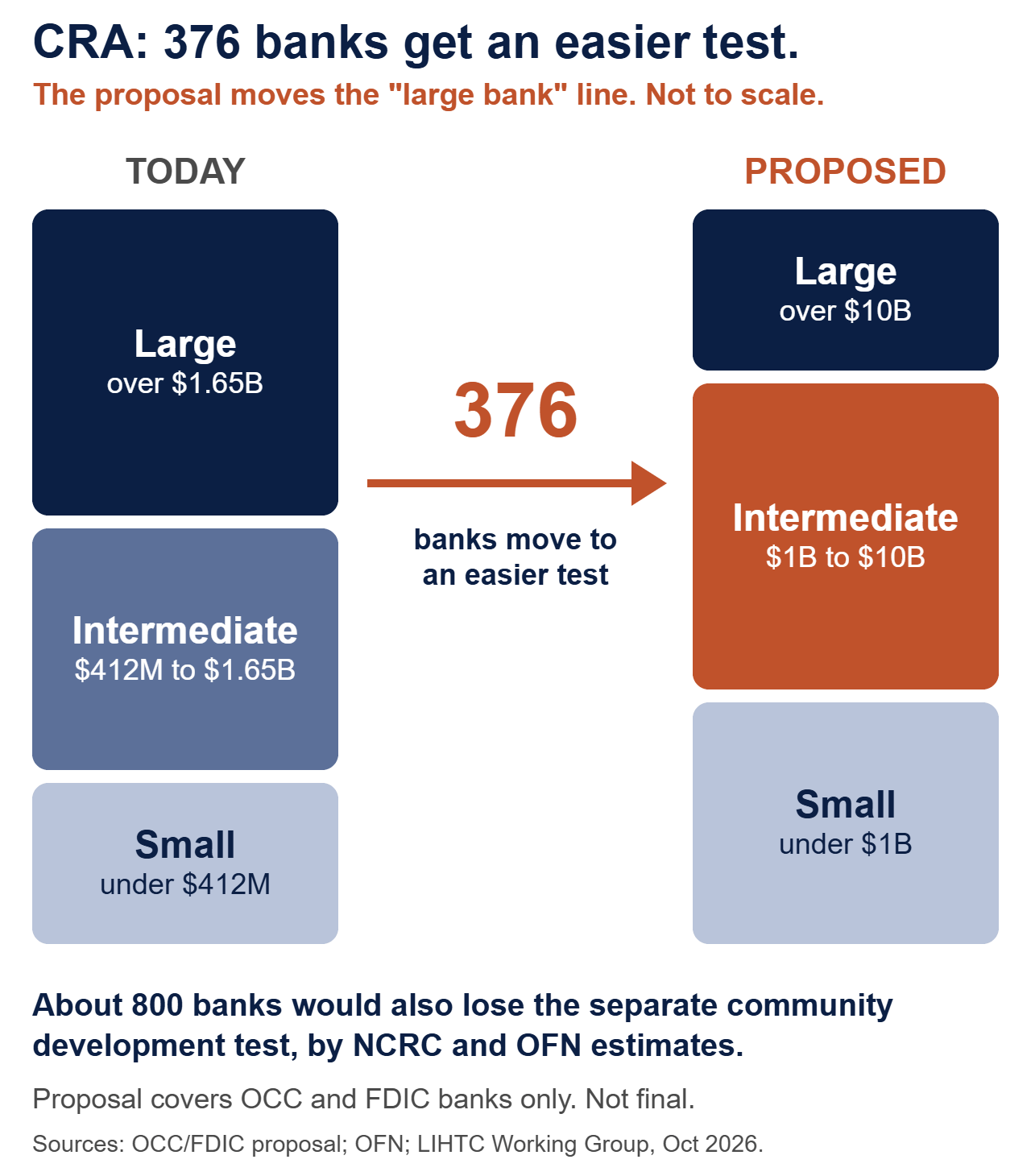
Sources: OCC and FDIC proposal; OFN; LIHTC Working Group letter, October 13, 2026. Bank counts are estimates and differ by who counts what.
In plain English: CRA grades banks on how well they serve lower income communities. Big banks take the hardest test, which includes a separate investment test where buying housing credits counts directly. The proposal raises the “big bank” line, so fewer banks take that test. Nobody knows yet whether the banks that move would still buy housing credits.
-
The big bank line moves from about $1.65 billion in assets to $10 billion. What that means: a bank with $5 billion in assets takes the hardest test today. Under the proposal it would take an easier one.
-
Small banks would be under $1 billion, up from $412 million. What that means: more banks would be small, and small banks skip the community development test.
-
376 banks would move from large to intermediate, by OFN and the LIHTC Working Group’s count. NCRC counts 417. What that means: roughly 376 to 417 banks would leave the separate investment test, the one that rewards buying housing credits.
-
About 800 banks would become small banks and lose the separate community development test, by OFN’s count. NCRC says 814 and about $500 million a year of community development loans and investments at risk. What that means: those banks would no longer be separately graded on community development.
-
Intermediate banks would need a Satisfactory on the lending test to earn an overall Satisfactory, per OFN. What that means: a bank could pass on strong lending alone, with little community investing.
-
The banks’ side: the FDIC estimates the changes save about 106,000 compliance hours and about $10 million a year at the banks it supervises. What that means: less reporting for banks. The Consumer Bankers Association also wants a framework that survives changes of administration.
2. CRA: What It Could Mean for the Housing Credit
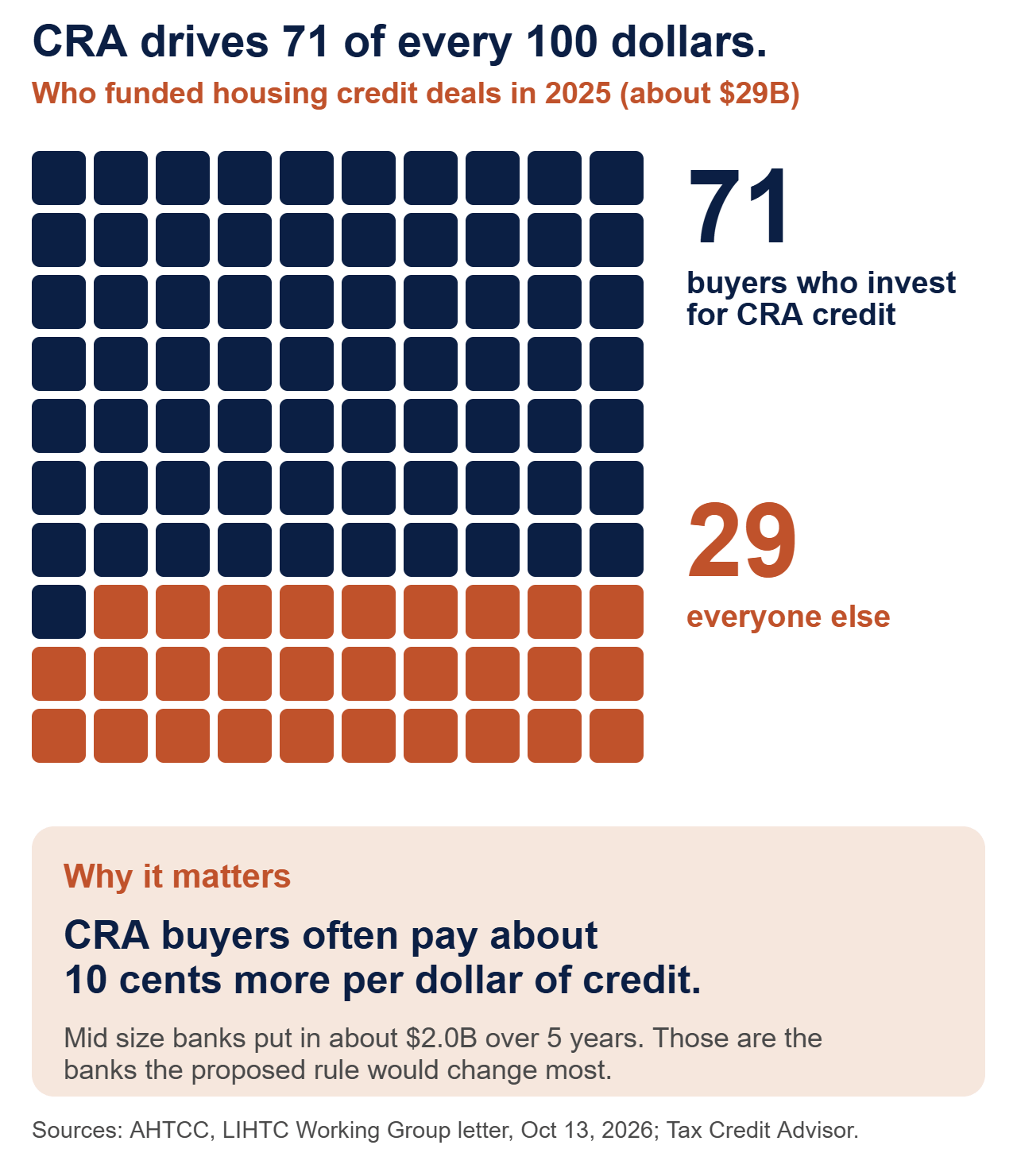
Sources: Affordable Housing Tax Credit Coalition survey and market data, in the LIHTC Working Group letter, October 13, 2026; Tax Credit Advisor. Yearly and percent figures are my math from their numbers.
-
2025 housing credit equity was about $29 billion, and about 71 percent came from CRA motivated institutions. What that means: about $20.6 billion came from buyers who invest, at least in part, for CRA credit.
-
At least 108 banks between today’s line and the proposed one invested about $1.6 billion over five years. Extrapolated to the market, about $2 billion. What that means: roughly $400 million a year, about 1.4 percent of 2025’s equity. It is a small slice of the total.
-
About one third of that equity went to rural markets. In an industry wide CohnReznick sample, 8.1 percent did. What that means: these banks put in about four times the rural share, so rural deals have the most to lose.
-
Tax Credit Advisor reports CRA motivated investment often adds about ten cents per dollar of credit. What that means: on a deal with $10 million of credits, ten cents is about $1 million of equity.
-
The September median net price was 82.3 cents, down from 90 cents in September 2023. What that means: 7.7 cents less per dollar, about $770,000 less equity on that same $10 million of credits.
-
The other view. NAAHL’s CEO said, “We don’t expect banks to suddenly stop investing in LIHTC,” and expects mid size banks to become more selective on deal size and geography. A Nixon Peabody partner expects investment to stay about the same or edge up in the near term. What that means: the effect could be pickier buyers, not fewer.
-
An open question. OFN reads the draft as possibly leaving out standalone housing credit equity when it defines complex investments. The LIHTC Working Group asked regulators to say plainly that it counts.
No one has measured the effect yet. That is the honest state of the evidence.
Need, demand and supply, as percent
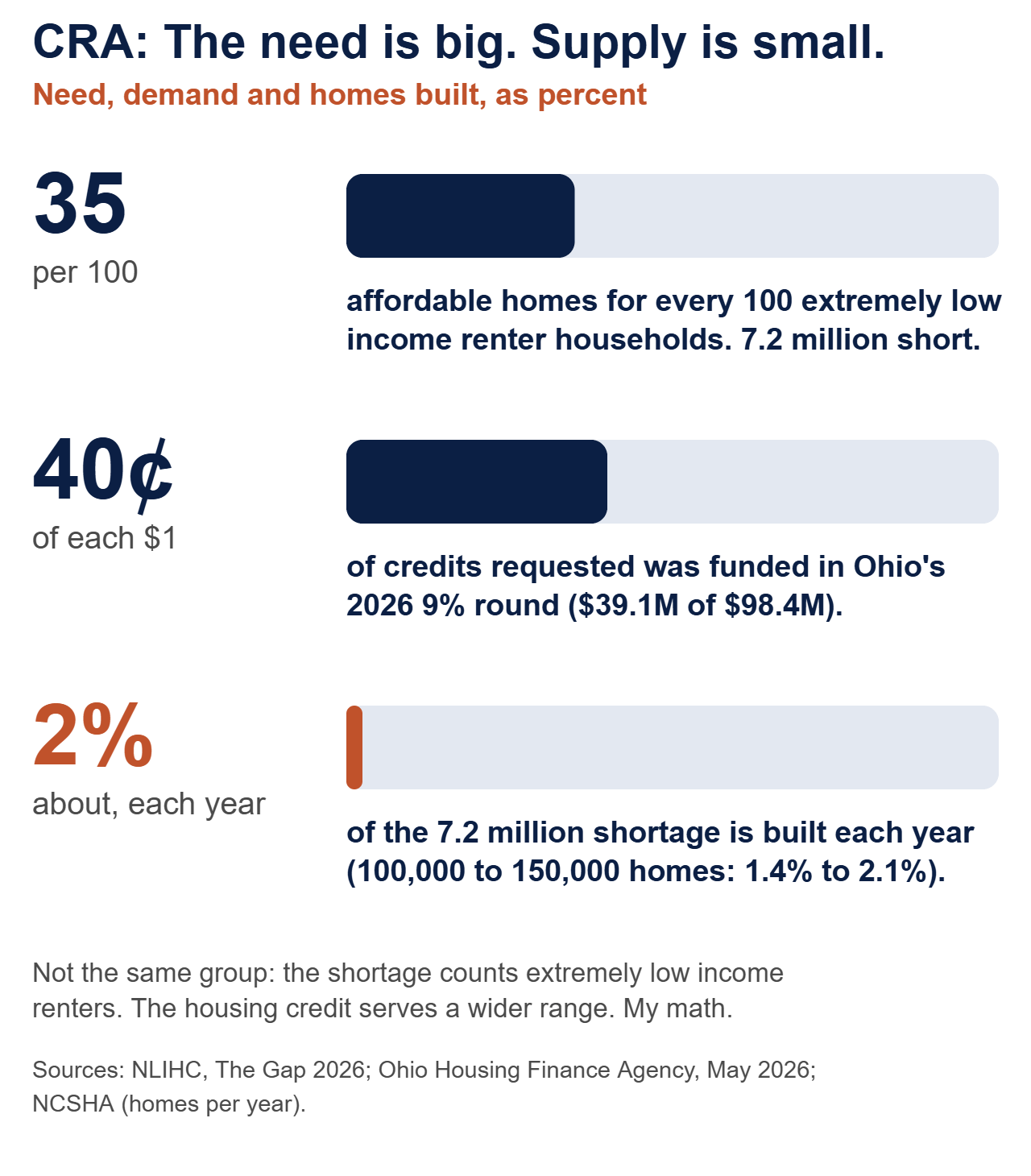
Sources: NLIHC, The Gap 2026 (March 2026); Ohio Housing Finance Agency, May 21, 2026; NCSHA for homes per year. The percentages are my math.
-
NLIHC counts a shortage of about 7.2 million affordable and available rental homes for extremely low income renters: 35 homes for every 100 such households, out of about 11 million households. What that means: 65 of every 100 of those households have no affordable home available to them. 74 percent pay more than half their income for housing.
-
In Ohio’s 2026 9 percent round, 62 applications asked for more than $98.4 million of credits. The state awarded about $39.1 million to 25 projects. What that means: about 40 cents of every dollar requested was funded, and 37 of 62 applications got nothing. That is one state and one round. An older advocacy letter said agencies typically see requests for two to three times the credits available, but I did not find a current national figure.
-
NCSHA says the housing credit adds 100,000 to 150,000 homes a year. What that means: 1.4 to 2.1 percent of the 7.2 million shortage each year. At that pace it would take roughly 48 to 72 years to close. These are not the same group: the shortage counts extremely low income renters and the credit serves a wider range, so this is a rough yardstick.
-
Two kinds of demand. The banks’ explanation is supply and demand among investors: more credits for sale, so a lower price. That may be true. But the demand from people and from developers is much larger than the supply, and a lower price does not shrink it. It shrinks what each credit can build.
3. CRA: The People, and What We Ask Next
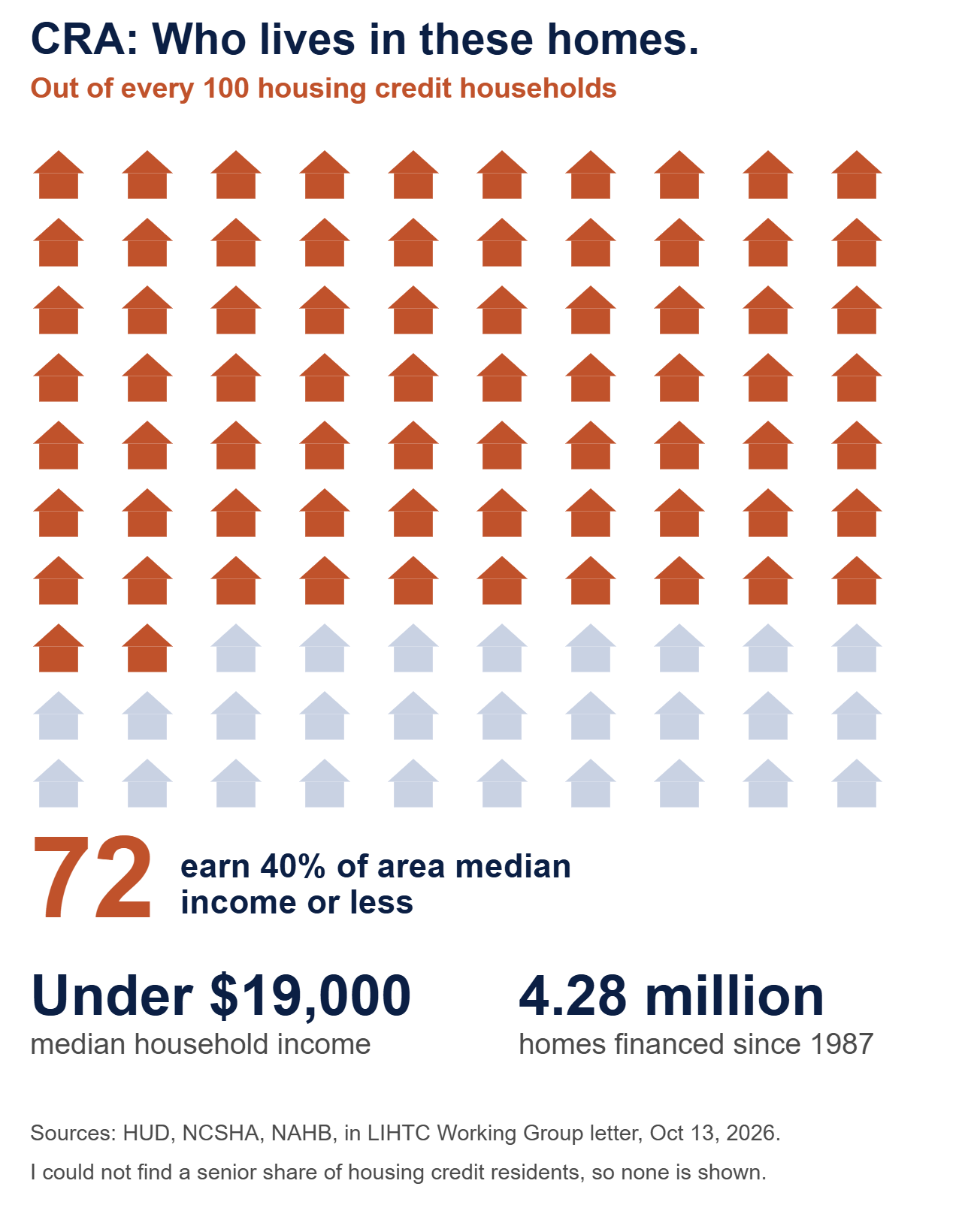
Sources: HUD, NCSHA and NAHB, in the LIHTC Working Group letter, October 13, 2026.
-
The housing credit has financed 4.28 million homes from 1987 through 2025. What that means: about 110,000 homes a year on average (my math).
-
The median household earns under $19,000. What that means: less than $1,600 a month. At 30 percent of income, rent it can afford is about $475 a month.
-
About 72 percent earn 40 percent of area median income or less. What that means: about 7 of every 10 households.
-
12 million low income renters pay more than half their income for housing, per Harvard. What that means: after rent, little is left for food, medicine and transportation.
-
Seniors: LeadingAge, which represents aging services providers, says the proposal “would further limit opportunities for affordable housing for older adults.” That is their claim, and they give no figure. I could not find the share of housing credit residents who are seniors.
What our industry has asked regulators for
-
The LIHTC Working Group asked for a large bank line no higher than $3.25 billion. What that means: more banks would stay in the investment test. It also asked for express confirmation that housing credit fund interests count, and a clear path for credit outside a bank’s local area, especially rural.
-
NAAHL circulated a national sign on letter, and the National Housing & Rehabilitation Association joined it. The ACTION Campaign offered a template letter.
-
AHTCC is also pushing a separate bank capital rule: cut the risk weight on housing credit investments from 100 percent to 20 percent, and no more than 50. It filed in June with a coalition of 26 other organizations. What that means: a bank would hold about one fifth as much capital against these investments, which makes them cheaper to hold.
-
The National Housing Conference called for the proposal to be withdrawn.
What Congress did. The ROAD to Housing Act raised the cap on bank public welfare investments, including housing credit developments, from 15 to 20 percent of capital and surplus. What that means: banks have room to invest more. It does not require them to.
The tie to bank profits. In my earlier piece on bank profits, profits ran about $73 billion a year above 2023, while CRA housing investment rose about $2.5 billion. What that means: about $29 more in profit for every $1 more in CRA housing investment (my math). The banks in the middle of this proposal put in about $400 million a year, by the industry’s own survey, roughly half of one percent of that profit gain. That is a rough yardstick, since the groups are not the same. CRA is the rule meant to connect what banks earn to what they invest in communities. If 376 banks face an easier test, the investing part counts for less in their grade.
The question. Everything I can document is about the rules and about bank capital treatment. That work matters, and I support it. What I have not seen is an ask built around the seniors and families in the homes.
-
Banks: what would put a slice of record profits into housing credits at community level pricing? Does the new 20 percent cap give you room?
-
Developers, owners and managers: did you file a comment, or hear that your sponsor did?
-
Syndicators: are banks in the middle of the size range changing what they bid?
-
Advocates for seniors and families: what do residents need us to ask for?
Reply, comment or message me. I will read every one.
Sources: NLIHC, The Gap 2026; Ohio Housing Finance Agency, May 2026; OCC and FDIC proposed rule, Federal Register, August 12, 2026; LIHTC Working Group comment letter, October 13, 2026; Affordable Housing Tax Credit Coalition, October 1, 2026; NAAHL statement, August 2026; NCRC comment letter, October 13, 2026; OFN, August 27, 2026; Novogradac, August 2026; Tax Credit Advisor, September 14, 2026; National Mortgage Professional, August 5, 2026; Mayer Brown, August 2026; Arnold & Porter, August 2026; LeadingAge; NH&RA, October 7, 2026.
David Petroni is the owner of DFP Enterprises and author of The 100-Year Pivot. He has spent his career in affordable housing development across 19 states.