

I asked a real question in my last piece and I want to actually answer it instead of just repeating that banks are pulling back. So I went looking. What I found is not doom and gloom. It is a specific, fixable regulatory gap, and there are real organizations already pushing to fix it.
A note before you read this: the CRA rule at the center of this piece is genuinely up in the air right now. Nobody in a position of authority has said out loud, on the record, where it is actually heading next. Done right, this rule is a real resource for this industry. My hope is that legislative leadership can see through the fog and set it back on track.
What Actually Happened to CRA
In October 2023, federal regulators finalized a genuinely good CRA rule. It expanded the geography where banks could get CRA credit for LIHTC investments, from just their local branch footprint to a statewide or regional area. Novogradac and other industry analysts expected this to increase competition among bank investors and push pricing up, not down. That was the plan.
It never took effect. Litigation from banking trade groups got it enjoined before the applicability date, and in 2025 regulators moved to formally rescind it and revert to the 1995 framework. That is roughly two years of regulatory limbo, landing at the exact moment the One Big Beautiful Bill Act permanently expanded the credit supply.
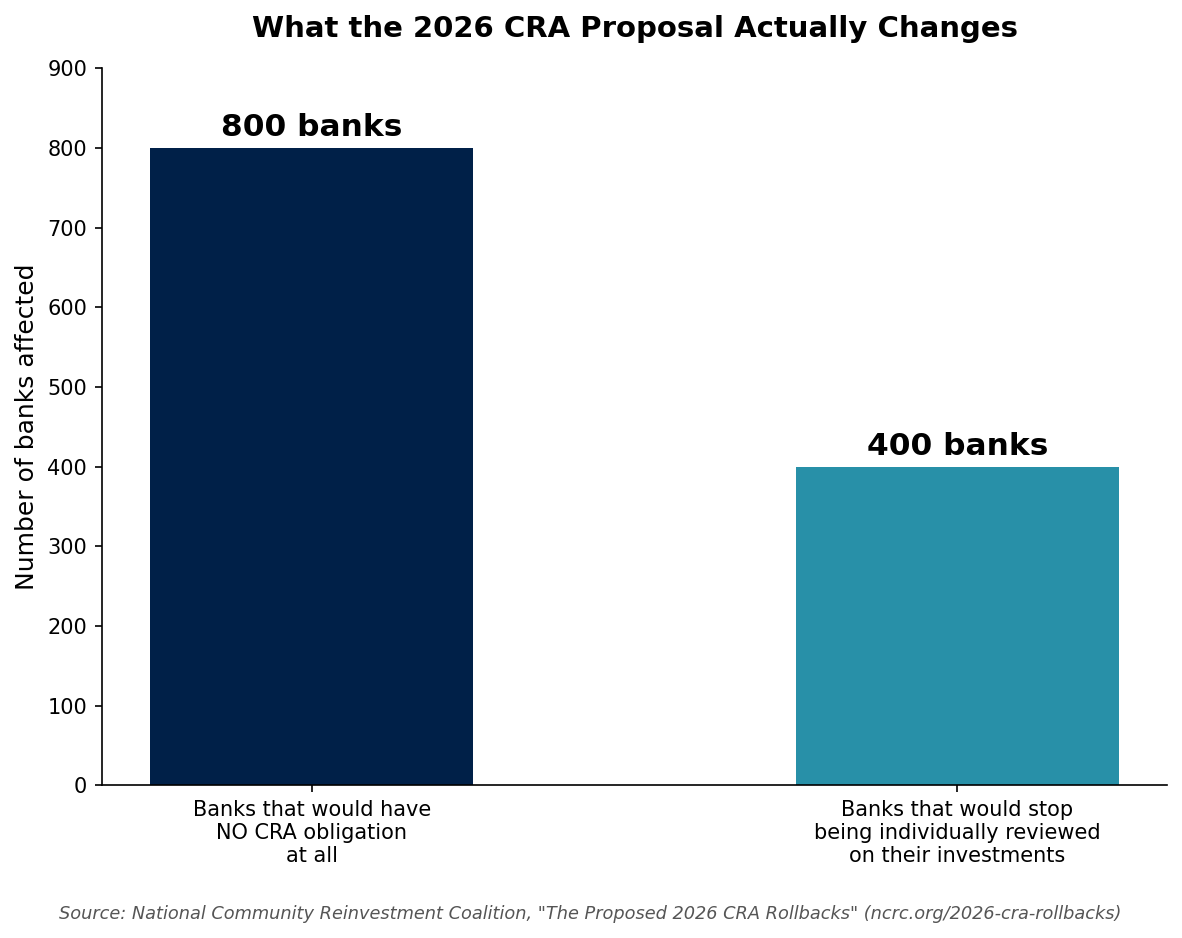
The 2026 proposal on the table now does not just revert to the old rules. It raises the small bank asset threshold, which removes community development obligations from more than 800 banks entirely and takes another 400 out of separate evaluation for investments. That estimate comes from the National Community Reinvestment Coalition’s own analysis of the proposed rule. The National Housing Conference has flagged that this hits smaller markets hardest, the ones that depend on a handful of local banks willing to underwrite deals that do not meet big metro yield targets.
So yes, I think this is what is happening. Soften the rule that would have grown bank demand, then widen the number of banks with no CRA obligation at all, and you get exactly what I am seeing on the ground: banks defaulting to pure economic return logic because the regulatory reason to do otherwise got tangled in litigation and then walked back.
Where is the actual traction on this, since three organizations asking is not the same as anything moving. The comment period on the current proposal runs through October 13, 2026, and it is still open. There is already one data point showing regulators respond to pressure: an earlier version of this proposal, a straight rescission back to the 1995 rules, drew 47 formal comments, and the agencies chose not to finalize it, issuing this different proposal instead. Right now, the National Community Reinvestment Coalition and 374 other organizations have formally petitioned to extend the comment window from 60 to 120 days. That is the traction that exists today. Whether it produces a better outcome than the current proposal is genuinely unknown.
I should also correct my own framing here. I said more supply without more demand dilutes pricing, and that is true for the bank CRA channel specifically. But it is not the whole capital story. FHFA doubled Fannie Mae and Freddie Mac’s LIHTC investment caps from 1 billion to 2 billion dollars each in 2025, explicitly because OBBBA’s expanded supply needed more capital behind it. That is a real answer to where oversupply can attract capital outside of banks chasing yield: a federal policy lever, not a private investor decision. It is also the one part of this story that has actually kept pace with the supply increase so far.
The Part That Is Not Doom and Gloom
Real organizations are already pushing back on this, and their ask is specific. The National Association of Home Builders is on record telling regulators that at the exact moment OBBBA is expanding credit allocations, LIHTC investments need to stay strongly encouraged and rewarded with CRA credit, not less.
The National Council of State Housing Agencies is asking regulators to move fast and finalize whatever framework they land on, because uncertainty itself is what is jeopardizing bank participation right now. The National Housing Conference is asking the Federal Reserve to actually be included in the process, since the current proposal moved forward with only two of the three regulators involved.
Three organizations, a direct line to the agencies writing this rule, and the same basic ask each time: finish the rule, keep LIHTC rewarded, and do not shrink the number of banks with skin in the game.
Ohio Proved the Model Works When It Is Funded
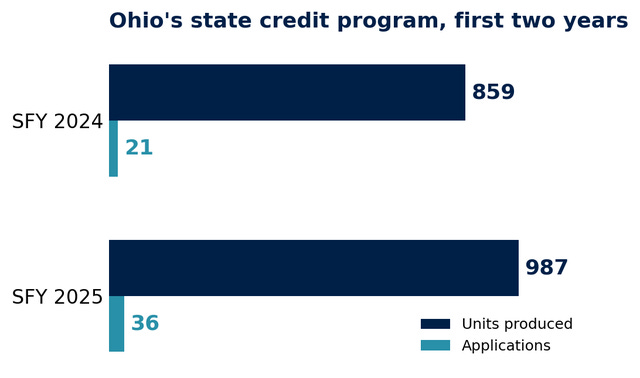
Whatever happens at the federal level, states are not waiting around. Ohio’s own state credit program financed 859 new units in fiscal year 2024 and 987 in fiscal year 2025, oversubscribed every cycle since it launched.
The question Ohio is actually facing is not whether the program works. It is whether Ohio becomes a flyover state again for private capital, the way it has been in past cycles, purely because of supply and demand mismatch, or because economic investor return thresholds are pricing Ohio deals out regardless of what the state program does. I do not think anyone has a clean answer to that yet. I think it is worth asking the question before it gets decided for us.
I sent a version of this argument to the White House this week, since I think the CRA piece deserves a direct look from someone with the authority to move it. Whatever happens there, Ohio has already shown what a well-funded state program can do on its own. That is the version of this story I would rather be telling.
David Petroni is the owner of DFP Enterprises and author of The 100-Year Pivot. He has 38 years of experience in affordable housing development across 19 states.