

I am passionate about this program. 37 years inside it, alongside the practitioners and advocates who have carried it for four decades, and what happens to the capital side next reaches every one of us. Banks pulling back from LIHTC equity is the story, and it deserves names.Last week on LinkedIn I wrote about a Chicago equity fund that will not deploy any of its 2026 raise in Ohio unless pricing comes in at 70 cents on the credit dollar. Several practitioners sent the same question back to me. Who, specifically, is doing this. So this piece names the banks.
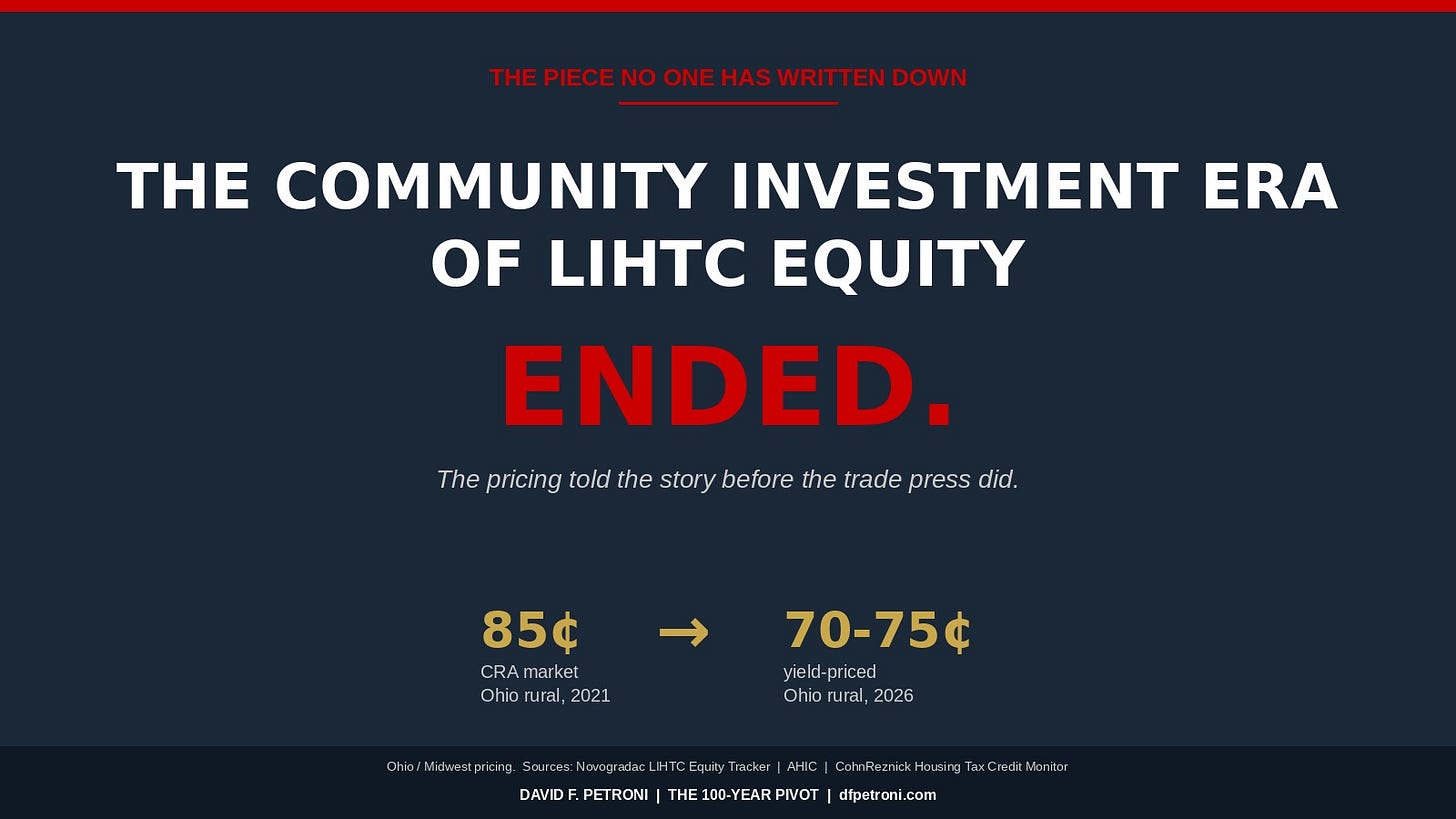
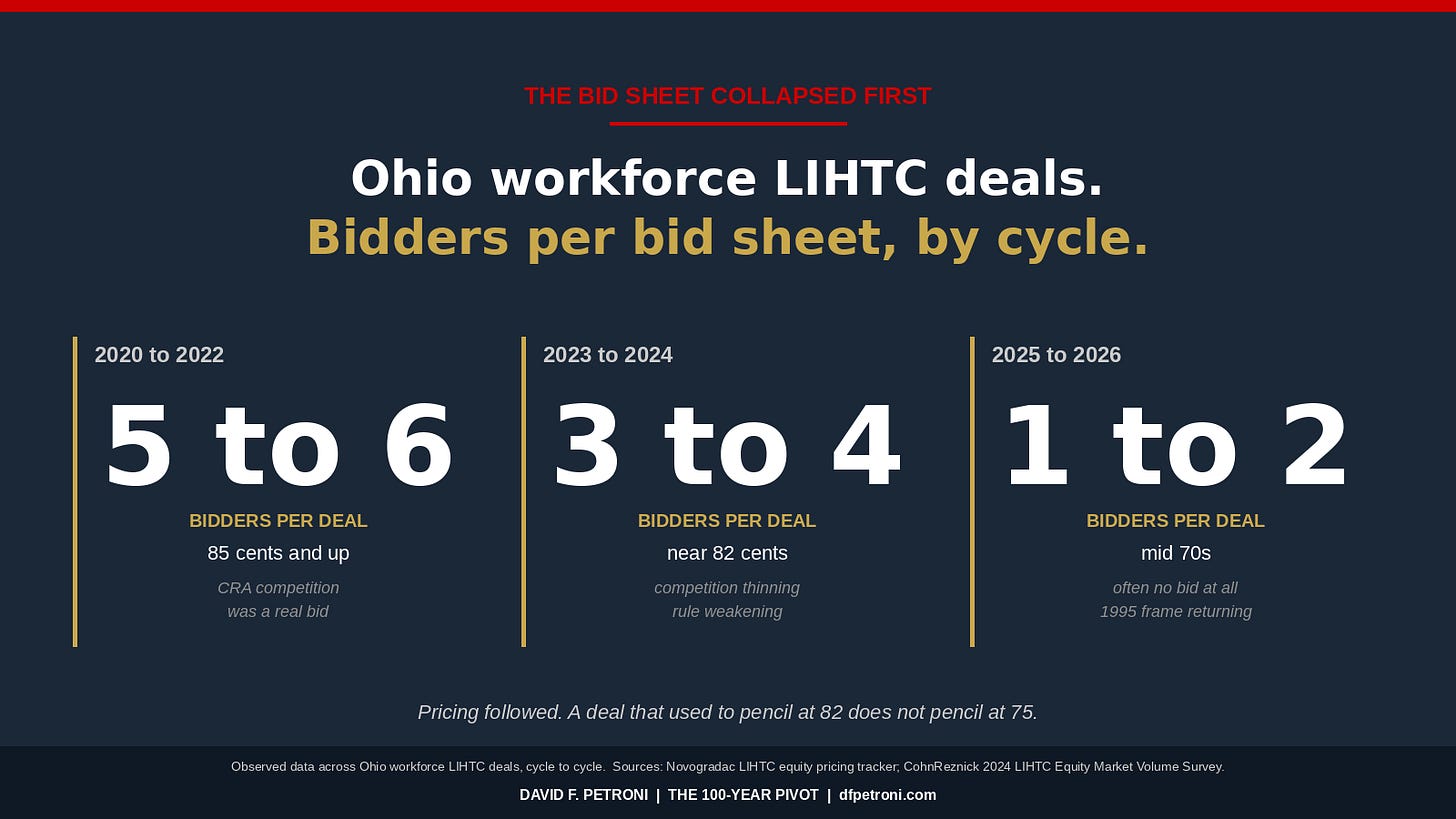
The frame that kept bank LIHTC equity behaving like community capital is being unwound. On July 16, 2025 the OCC, Federal Reserve, and FDIC jointly filed a Notice of Proposed Rulemaking to rescind the 2023 CRA Final Rule and replace it with the 1995 framework. The 2023 rule had tied bank LIHTC investment to local deposit footprints and explicitly recognized LIHTC and NMTC as qualifying CRA investments. It never took effect. A Texas district court enjoined it on March 29, 2024. The comment period on the rescission closed August 18, 2025. As of April 2026, every bank in this country is being examined under the 1995 rules.
CohnReznick’s 2024 LIHTC Equity Market Volume Survey reported $28.9 billion in total LIHTC equity, up 7.6 percent year over year. Approximately 80 percent came from banks. The median LIHTC net equity price held at 83.9 cents per credit through mid-2025, down from a peak of 86.4 cents earlier in the year. The median hides a tail. Small markets and rural deals with thin CRA investor competition are clearing at 70 to 75 cents. A deal that pencils at 80 cents often, not always, does not pencil at 72. The Midwest workforce deals I underwrite are in that tail.
These are our biggest teammates on the capital side. Five of them do most of the work. They built this program. They are not the villains of this story. They are the institutions that made LIHTC function for forty years, and they are responding now to an incentive landscape that has changed underneath them. Naming them is the prerequisite for an honest conversation about what comes next.
JPMorgan Chase
Chase is the largest LIHTC equity investor this program has ever had, directly and through the syndicators. In 2024 the firm extended $6 billion in debt and equity for affordable housing. Through the first three quarters of 2025, $5 billion more, projected to create or preserve 39,000 units. Cumulative 2021 through 2025: over $50 billion, 410,000 plus units. John Kavanaugh of Chase Community Development Banking told the AHIC Fall Summit panel in October 2025 that Chase is on track for a record volume year and projects similar levels for 2026.
Those numbers describe the headline pace. They do not always describe the marginal deal. Last week’s LinkedIn post named the shift I am seeing in term sheets. When the institution financing 290 unit complexes in East Hollywood and $189 million Bronx projects applies the same yield discipline to a 40 unit rural Ohio deal, the rural deal does not get the same pencil. Chase’s public commitments are not the question. The underwriting drift on the deals that do not make the press release is the question.
What I would want to see from JPMC is straightforward. Publish the 2024 and 2025 LIHTC equity deployment by state, by credit type, and by 9 percent versus 4 percent allocation. The aggregate is large. The distribution inside it would tell the rest of the story.
Wells Fargo
Wells Fargo does not publish an annual headline LIHTC equity commitment. Its affordable housing work shows up deal by deal. Cooper Gardens in the Bronx closed in October 2025 with $67 million of Wells Fargo LIHTC equity plus a $72 million letter of credit. Citrus Glen in Orlando took $33 million of Wells equity in a $94.77 million package. Gresham Civic Center in Oregon took $25.6 million of Wells equity in a $63.66 million package. Fort Greene in Brooklyn took $97 million of Wells Freddie Mac lending for the Tredway and ELH acquisition of seven Section 8 buildings.
The deals are real. They are also metropolitan. Bronx, Orlando, Gresham, Brooklyn. The common thread is dense CRA assessment area overlap. Wells files a public CRA commitment report to the City of Philadelphia every year that lists Dream.Plan.Home $5,000 LMI closing cost credits and Homebuyer Access $10,000 down payment grants. The bank runs a substantial, structured CRA program inside its eight market urban framework.
The question is what happens outside that framework. A freedom of information request on Wells Fargo’s 2024 and 2025 LIHTC equity by state would show whether deployment tracks the coastal and metro pattern of the press released deals, or whether rural and small Midwest markets continue to get capital at rates that underwrite. My working assumption, from talking to the syndicators who run multiple investor funds, is that the deployment mostly tracks the press. I could be wrong, and I would welcome being shown the data.
Bank of America
Bank of America’s Community Development Banking announced $7.4 billion in 2025 affordable housing debt and equity financing. 87 developments, 68 cities, 21 states, 11,000 plus affordable units. Maria Barry has run that platform for close to four decades. The number is real, and the platform is one of the deepest in this industry.
Inside that $7.4 billion is a line that deserves its own sentence. Banc of America Community Development Company closed $357 million of direct and fund equity for workforce housing, up to 120 percent AMI, in 2025. Florida, Georgia, Texas, California, Colorado, Virginia, North Carolina. 3,400 workforce units.
Less than five percent of BofA’s public affordable housing number is workforce. The rest is below the workforce band, which is appropriate for deeper subsidy LIHTC. But the workforce specific slice concentrates in exactly the Sun Belt markets where BTR institutional capital has deployed most aggressively over the past five years. Florida, Georgia, Texas. The overlap is probably not accidental. BofA’s workforce LIHTC footprint tracks roughly the same map as the BTR capital it competes against for basis on comparable land.
The question I would ask Maria Barry and her team, as someone who respects how that platform has been built, is what BofA’s 2024 and 2025 Midwest workforce LIHTC deployment actually looks like. Not the Sun Belt. Not California. The Midwest. If the number is small, that tells us something about how much of the program is still being priced as community investment.
Fifth Third
Fifth Third does not publish a headline annual LIHTC equity number. Its Community Development Company operates across an 11 state footprint that covers Ohio, Michigan, Illinois, Indiana, Kentucky, Tennessee, North Carolina, Georgia, Florida, and the Carolinas. In September 2024 the Fifth Third New Markets Development Company received a $50 million NMTC award from the Treasury. In January 2026 Fifth Third New Markets Development Company II received an $85 million NMTC award in the Treasury’s December 23, 2025 allocation, one of 142 CDEs in a $5 billion round.
NMTC activity is not LIHTC activity. The reason to name Fifth Third’s NMTC cadence is straightforward. It shows a bank actively pursuing community development tax credit opportunities at scale. The same bank, operating in the same Ohio markets where I underwrite workforce deals, mostly does not surface as a bidder on the small market 4 percent LIHTC projects I see. My phone does not ring from Fifth Third on a 40 unit rural Ohio deal. The silence is not because Fifth Third is not capable. Susan Thomas runs the CDC. Kala Gibson runs corporate responsibility. Both are experienced. The silence is likely because the deal does not clear the current yield screen.
What I would ask Fifth Third to publish is a 2024 and 2025 LIHTC equity deployment list by Ohio county. Warren, Montgomery, Butler, Hamilton, Greene, Clark. The footprint sits inside Fifth Third’s assessment area for every one of those counties. The deployment number would be specific, and it would tell the Ohio-facing part of this story better than anything I can say from my desk.
Huntington
Huntington’s Community Impact Corporation operates across a 12 state footprint that covers every state where Fifth Third operates, plus Minnesota, Wisconsin, West Virginia, and Pennsylvania. Huntington publishes a five year Community Investment Plan framework. In its most recent impact reporting, one surfaced LIHTC deal: a $26 million LIHTC equity investment paired with $598,000 in solar tax credits, working with Kaweah Management Company and Pacific West.
One deal is a data point. A plan is not always the same as deployment. The bank that serves Columbus, Cincinnati, Dayton, Toledo, and every small Ohio town in between has a Community Investment Plan on paper. The question is whether the LIHTC equity line in that plan is actually being deployed in the same small markets the plan nominally covers. The $26 million deal I could find is not in Ohio.
What I would like to see from Huntington is an honest measurement of the Community Investment Plan against actual LIHTC deployment, county by county, inside the same 12 state boundary the plan covers. If the deployment is clustered in metros, the plan is, fairly or unfairly, not yet doing the work the plan describes.
Banks Pulling Back From LIHTC: What Walked Away
The LIHTC credit, as an asset class, is the lowest default tranche in community finance. CohnReznick’s 2025 Affordable Housing Credit Study reported a cumulative default rate of 0.47 percent from 1986 through 2024, and no new foreclosures since 2021. 0.47 percent cumulative default across forty years of a program that financed over 3.7 million housing units. The banks retreating at the margin are not retreating on credit risk. They are recalibrating on yield and on the regulatory frame that used to require them to book the investment as community capital.
Anyone who reads “bank pulling back” as a risk signal has the story backwards. The asset did not get riskier. The rule that required banks to price it as community investment got rescinded.
The policy levers that are on the table
The Affordable Housing Credit Improvement Act had two real wins in the July 2025 reconciliation package: the 4 percent bond test was reduced from 50 percent to 25 percent, and the 9 percent credit authority was increased by 12 percent. A 30 percent basis boost for rural preservation takes effect in 2026. OBBBA restored 100 percent bonus depreciation for property acquired after January 19, 2025. NMTC was made permanent at $5 billion per year. FHFA doubled Fannie Mae and Freddie Mac LIHTC equity capacity.
The Workforce Housing Tax Credit Act, targeting 60 to 100 percent AMI units that sit between LIHTC and market rate, was introduced in the last Congress and awaits reintroduction. That piece is not optional. The gap it would fill is the same gap every one of the five banks above points to as its workforce slice.
These levers do not replace the CRA anchor. They partially offset. Anyone pushing affordable housing policy in 2026 is pushing for these levers while the larger reanchoring question sits unresolved.
The whole ladder
I own workforce LIHTC deals in Ohio. My personal capital stack depends on workforce pricing holding. A policy fight pitched only to protect that tier protects the part of the program that can, in a rough cycle, often carry itself on hard construction debt. The fight that matters for the next five years is for the tiers that cannot. Permanent supportive housing for people coming out of homelessness. 30 percent AMI units in the markets where cost burden is highest. Rural preservation of the stock that houses people who cannot chase the capital.
When bank LIHTC equity becomes yield capital, every tier of our industry loses. The tiers furthest from yield lose first. PSH and 30 percent AMI deals do not pencil at 72 cent pricing without deeper subsidy, and the deeper subsidy is not in the pipeline to absorb the gap.
The five banks named above are unlikely to publish the state by state deployment data that would let us measure the retreat specifically. That is the first ask. The second ask is that the Workforce Housing Tax Credit Act get reintroduced, scored, and moved. The third ask is that the CRA reconsideration happening right now at the OCC, Fed, and FDIC includes a reanchoring mechanism that restores the deposit footprint connection the 2023 rule tried to formalize.
The rule is rescinded. The capital is drifting. The program was built for a ladder, and the ladder still exists. We just have to keep enough of our biggest teammates on the capital side standing at the base of it.
What are you seeing in your market, and if CRA is not the lever, what is?
—
David Petroni is a real estate practitioner with 37 years in affordable housing across 19 states. The 100 Year Pivot is available on Amazon (https://a.co/d/0c3YEcol). The Housing Practitioner publishes weekly at davidpetroni.substack.com.
Sources: CohnReznick 2024 LIHTC Equity Market Volume Survey; CohnReznick Housing Tax Credit Monitor September 2025; CohnReznick 2025 Affordable Housing Credit Study; AHIC Fall Summit 2025 Investor Panel recap; Federal Register NPR July 18, 2025 Community Reinvestment Act Regulations; OCC Bulletin 2025-18; JPMorgan Chase November 2025 press release; Bank of America Community Development Banking February 2026 press release; Wells Fargo Cooper Gardens October 2025 and Citrus Glen, Gresham Civic, Fort Greene deal announcements; Fifth Third Bancorp January 2026 NMTC award press release; Huntington Community Impact Corporation End of Year Book; Arbor Single Family Rental Investment Trends Report Q2 2025; Berkadia Beyond Insights August 2025; Novogradac Community Development Tax Credits 2025
Related from Regulation:
Working an affordable housing deal?
Get a Subsidy Layering Review | See All Services | Get in Touch