

When the Vision Was Sound
When Congress created the Low Income Housing Tax Credit in 1986, the framework made sense. Robert Packwood, Dan Rostenkowski, Tip O’Neill. A Republican senator and two Democratic House leaders built a bipartisan framework on the premise that tax incentives could produce housing without direct government expenditure. That kind of governing feels distant now, in a Congress where Senator Fetterman has to remind his own party that country comes before party. But in 1986 it was just how the work got done.
The LIHTC practitioners who built the infrastructure around the credit believed the system could scale. Barry Zigas at the National Low Income Housing Coalition. Cushing Dolbiere who founded NLIHC. The teams at Enterprise Foundation and LISC who stood up the equity syndication market. They were right. For forty years the program produced millions of units.
The Texas QAP ran about 30 pages. A developer could read the rules over lunch and pencil the deal by dinner. The 2025 version runs 222. And Texas is considered one of the more straightforward states.
Something happened along the way that nobody designed for.
What the LIHTC Practitioner’s Deal Looks Like Now
I am assembling a 4% bond deal right now. Tax credit equity, bond financing, HOME funds, Housing Trust Fund dollars, gap funding, deferred developer fees, state credits, local contributions. Four to eight sources moving through separate approval processes, each with its own timeline and compliance checklist.
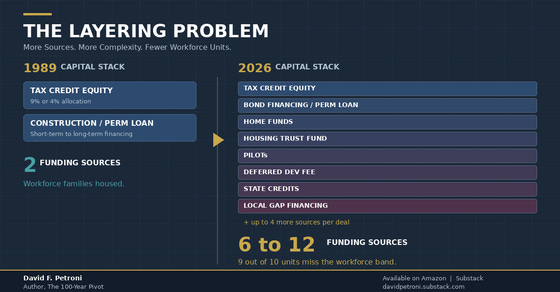
This week I spent three days reconciling the same subsidy layering numbers across three different agency formats. Each reviewer needs the data structured their way. Transaction costs on a deal like this run $200,000 to $500,000 in legal and administrative expenses before a single unit gets built. And the timeline keeps stretching.
The 9% competitive credits have been captured. QAP scoring inflation pushed them toward the deepest targeting, and the advocacy community made sure they stayed there. Nine out of ten 9% units miss the workforce band entirely. That leaves the 4% bond program as the primary vehicle for workforce housing production. And the 4% deals carry the heaviest capital stacks in the system.
A colleague who has been building apartments since the late 1980s made an observation that has stayed with me. The market already produces workforce housing when it is allowed to function. Land costs, construction costs, zoning restrictions. Remove those barriers and housing gets built for all income bands, including the workforce band between 60 and 80% AMI.
He stopped building tax credit deals. Not because the argument was wrong. Because the math stopped working. Real estate development carries enough complexity on its own. Adding half a dozen funding sources and half a million in transaction costs changed the equation. The subsidy was no longer worth the cost of assembling it.
Two Problems Layering Into One
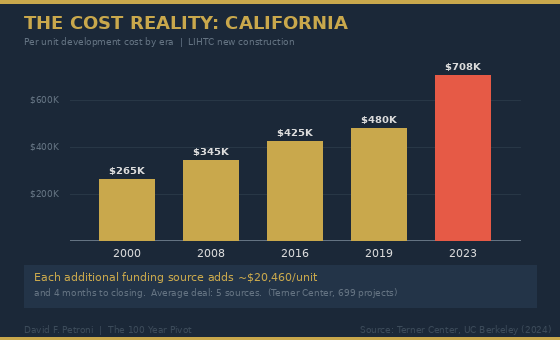
We now have two systems failing simultaneously. The market does not produce workforce housing on the timeline families need. And the 4% bond program, the one vehicle designed to operate at scale, has accumulated so much procedural weight that assembling a deal takes four to eight funding sources, hundreds of thousands in transaction costs, and months of underwriting. In California, the Terner Center found each additional source adds roughly $20,000 per unit in soft costs and four months to the closing timeline. The average California deal now carries five sources.
The numbers tell the rest of the story.
The supply side argument about removing barriers is sound. But it does not account for the families who cannot wait twenty years for filtering to deliver a unit they can afford. The subsidy expansion argument is also sound. But it does not reckon with the fact that complexity itself has become a barrier to production.
I have spent 37 years across 19 states assembling these deals. The complexity is navigable. But navigating complexity and simplifying it are not the same thing. The tools exist to get a deal through the process. They do not fix the process.
The real question is whether the financial architecture, the capital stack itself, can be retuned to function again. Or whether we keep layering process on top of process until the practitioners who know how to build these deals decide it is no longer worth the effort.
That is the dilemma. Not a policy debate. A math problem that practitioners face every time they open a new deal file.
Next issue: The Two Track Solution. What if we stopped asking LIHTC to do everything?
The 100 Year Pivot is available now on Amazon in paperback and Kindle.
https://a.co/d/0c3YEcol
David F. Petroni is the founder of DFP Enterprises, the author of The 100 Year Pivot, and a developer who has assembled tax credit transactions across 19 states. He also provides subsidy layering review and project based voucher structuring for developers navigating capital stack assembly. He writes The Housing Practitioner for practitioners who want analysis grounded in deal experience, not theory.
Subscribe to The Housing Practitioner for weekly analysis on workforce housing policy, LIHTC reform, and the financial architecture behind affordable housing.
Related from LIHTC:
Working an affordable housing deal?
Get a Subsidy Layering Review | See All Services | Get in Touch