

In Issue 4 I walked through the connection most people outside housing finance never see. Banks pay for most of the affordable housing built in the United States, about eighty percent of the equity behind it, roughly $8.9 billion a year. They do that for two reasons. The income banks earn on customer deposits is taxable, and federal housing tax credits are one of the cleanest ways to lower that tax bill. There is also a legal reason. A 1977 law called the Community Reinvestment Act, the CRA for short, requires banks to put money back into the neighborhoods where they take in deposits, and affordable housing is one of the most reliable ways to satisfy that obligation. Both incentives only work if people keep their savings in banks.
That assumption has started to wobble. Last summer Congress passed the GENIUS Act, which for the first time gave a federal blessing to stablecoins, the dollar-backed digital tokens that move money outside traditional bank accounts. If enough deposits leave for those rails, the tax math and the CRA math both shift at once, and the banks that fund affordable housing have less reason to keep doing it.
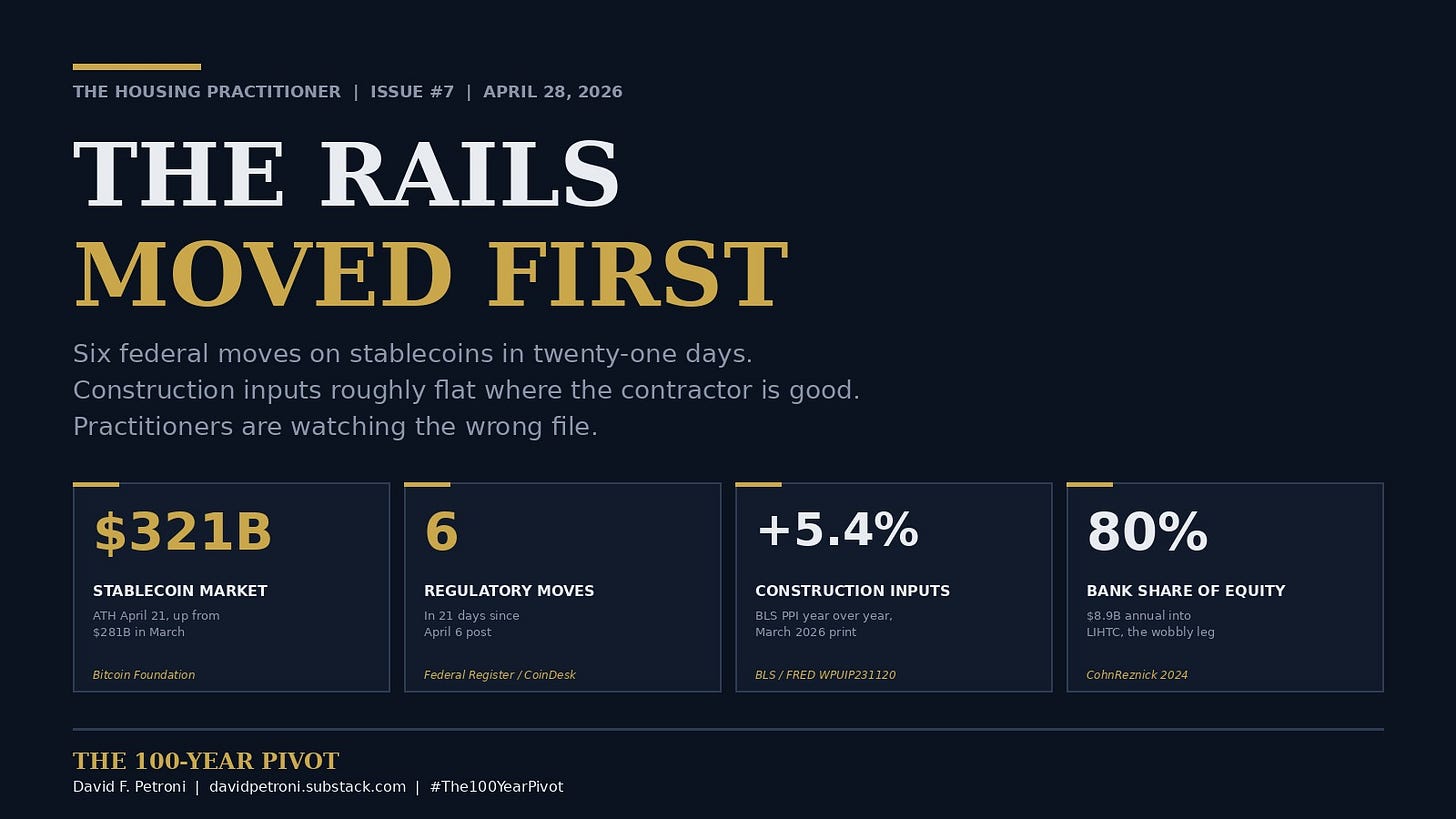
In the twenty-one days since I last wrote on this, the federal regulators moved six times to set the rules for those new digital rails. The LIHTC construction cost story everyone in housing keeps telling moved roughly not at all. The gap between those two files is the story for the rest of 2026.
What changed in twenty-one days
On April 8 the Federal Reserve published a research note showing the stablecoin market grew faster in the first three months of 2026 than in all of 2024. The same week the White House Council of Economic Advisers, the team of economists who advise the President, released its own paper arguing that banning stablecoins from paying interest would only modestly help bank lending. That study landed on one side of an active fight inside Washington over whether stablecoin issuers should be allowed to pay holders something that looks like interest.
Two days later, on April 10, the FDIC and FinCEN, the agencies that insure bank deposits and police money-laundering rules, posted their own proposed rules for stablecoin issuers. Those rules joined the OCC’s, which had hit the Federal Register in early March. The OCC is the agency that regulates national banks. Its public comment window closes May 1. The FDIC and FinCEN windows close June 9.
On April 13 the American Bankers Association, the trade group that speaks for the largest banks, pushed back on the White House study. The bankers argue that allowing interest-like rewards on stablecoins would drain deposits from community banks where lending is already thin, and that the policy question is deposit flight rather than bank-lending volume.
By April 14 the White House had announced a compromise. Pure interest on stablecoins stays prohibited. Rewards tied to using stablecoins for payments and platform activity are allowed. The fight that had blocked the broader CLARITY Act crypto bill all spring narrowed without closing.
This week three banking trade groups asked the OCC to keep the comment window open for sixty days after the final rule rather than after the proposal. That is a procedural way of saying the banking side wants the clock slowed while the rules are still being shaped.
The market number caught up to the file. Total stablecoin market value hit a fresh high of $318.6 billion on April 11 and crossed $321 billion on April 21, up from about $281 billion at the end of March, with USDT carrying roughly fifty-eight percent of the dollar-backed pool and USDC most of the rest.
That is six items in twenty-one days, none of them yet a final rule. The cumulative effect is that the geometry of where Americans can keep their money and what that money earns is being redrawn while the housing capital stack watches lumber prices.
The LIHTC construction cost story everyone is still telling
Most affordable housing developers will tell you their deals do not pencil because building costs ran. There is a number behind that claim. The federal Producer Price Index for the components and materials that go into construction was up 5.4 percent year over year in March. That is a real headline number. It is also a national average, which by definition hides the specific picture in any one market.
The picture I see closest, in non-urban projects in southwest Ohio, is closer to flat. Skilled general contractors who held their labor force together through a slow first quarter have open bid books. Concrete subcontractors are quoting below what they quoted nine months ago. Mechanicals run higher because copper is up, but that is the kind of cost that fits inside a deal. Lumber actually stepped back from a two-month bounce and now sits below its level twelve months ago.
This is broker-to-broker honesty, not optimism. The cost spike from 2021 through 2023 was real and brutal. We are no longer in that spike. Deals that genuinely cannot pencil at 2026 input prices were going to have a hard time at 2024 prices. The pencil problem on the workforce deal in front of me right now sits somewhere else in the stack.
Where the pencil problem actually lives
The way bank money becomes an affordable apartment building is more straightforward than the acronym soup makes it sound. A developer wins an allocation of federal Low Income Housing Tax Credits, called LIHTC for short. The developer sells those credits to a bank, often through a syndicator that pools many banks together to buy a basket of deals. The bank uses the credits to lower its tax bill. The developer uses the cash from that sale as equity to fund construction. About eighty percent of the equity that builds affordable housing in the United States flows through that pipeline, per the CohnReznick 2024 LIHTC Equity Market Volume Survey.
Two forces keep the pipeline open. The tax code tells the bank why to buy the credits, and the Community Reinvestment Act tells the bank where its investments have to land. Both forces depend on the bank holding deposits in the first place.
If deposits move out of banks toward stablecoin accounts, both forces weaken at once. Less deposit-spread income at the bank means less taxable income to offset, which shrinks the appetite for tax credits. With fewer deposits inside the geographic areas the CRA tracks, the obligation to invest there shrinks too. Stablecoins are one of several paths deposits can take. They are also the only path with a federal regulatory framework that came online last summer, plus implementing rules likely to be final inside twelve months.
This is a 2026 to 2028 capital risk rather than a 2026 closing-cost risk. Deals on developers’ desks today still close at 2025 pricing because the equity contracts are already signed. The deals being underwritten this summer are where the rail shift first changes the math, because the equity teams at the syndicators that pool bank money for housing read the same regulatory file the building side does not.
The CRA file did not move
The 2023 update to the Community Reinvestment Act, which would have modernized the standards for how banks meet their community obligations, has been frozen by a Texas federal court for nineteen months. Federal banking agencies have not moved on a replacement. The 1995 framework is what is operationally in place. Stablecoin deposits sit outside that framework entirely, with no equivalent obligation that follows a deposit when it leaves a bank balance sheet for a tokenized account.
I wrote in Issue 4 that this is the structural piece nobody in housing was at the table for. Twenty-one days in, that is still the case. Banks are at the table arguing about interest, the crypto industry is at the table arguing about rails, and the people who actually finance and build affordable housing have written nothing into either rulemaking record.
The OCC stablecoin comment period closes May 1, with the FDIC and FinCEN companion rules closing June 9. The window is narrow, and it is still open.
Reading the wrong file
I do not know how fast deposit migration runs, whether the bankers hold their position through the compromise, whether the extension request gets granted, or where the OCC final rule lands between late summer and fall. Those are real uncertainties on the timing.
The construction-cost spread is not where the deal gets repriced in 2026. The repricing happens on the difference between what a bank earns on a deposit dollar and what a stablecoin earns on the same dollar, and that pair of numbers is being defined inside the OCC and FDIC rulemaking right now.
Nineteen months in, the rules that connect bank deposits to community investment are still frozen in court. The rules governing the new digital alternative moved six times in the last three weeks. Reading the wrong file in 2026 will cost more than any lumber line item ever did.
The 100-Year Pivot. Available now on Amazon. Chapters 9 and 10 walk the CRA-LIHTC mechanics. Chapter 11 walks the digital-asset variable.
https://a.co/d/0c3YEcol
Subscribe to The Housing Practitioner: https://davidpetroni.substack.com
Sources
- Federal Reserve, “Stablecoins in 2025: Developments and Financial Stability Implications,” FEDS Note, April 8, 2026.
- White House Council of Economic Advisers, “Effects of Stablecoin Yield Prohibition on Bank Lending,” April 2026.
- OCC Bulletin 2026-3, “GENIUS Act Regulations: Notice of Proposed Rulemaking,” March 2, 2026 (Federal Register doc 2026-04089).
- Federal Register, FDIC NPRM 2026-06974 and FinCEN NPRM 2026-06963, both April 10, 2026.
- CoinDesk, “Bankers rebuff White House claim that stablecoin yield doesn’t threaten deposits,” April 13, 2026.
- CoinDesk, “Banks seek to slow down implementation of crypto’s GENIUS Act on stablecoin oversight,” April 22, 2026.
- FinTech Weekly, CLARITY Act April 2026 status reporting (Patrick Witt yield compromise, April 14, 2026).
- Bitcoin Foundation, “Stablecoin Market Cap Tops $321B,” April 21, 2026.
- Bureau of Labor Statistics, Producer Price Index for components and materials inputs to construction, March 2026 release.
- CohnReznick, 2024 LIHTC Equity Market Volume Survey.
- Independent Community Bankers of America, December 2025 deposit-migration analysis.
- U.S. Treasury Borrowing Advisory Committee, April 2025, deposit displacement scenarios.
- The Housing Practitioner Issue 4, “There Is No CRA for Crypto,” April 2026.
Related from Regulation:
Working an affordable housing deal?
Get a Subsidy Layering Review | See All Services | Get in Touch