

The Public Welfare Investment Cap: Where Congress Got Half of It Right
The Senate passed the 21st Century ROAD to Housing Act 89 to 10 on March 12. The bill raises the public welfare investment cap from 15% to 20%, which on paper expands bank capacity to invest in LIHTC equity.
On paper.
Most banks are not hitting the current 15% ceiling. OCC Part 24 data and industry reporting from TAAHP and Novogradac confirm it. The constraint is not how much banks are allowed to invest. It is how much they are willing to invest. And willingness tracks directly to CRA enforcement.
The proof is in the pricing. In markets where CRA pressure is strong, LIHTC equity holds near 84 cents per credit. Where CRA motivation is weaker, pricing has dropped to 70 to 75 cents. The 2023 CRA modernization rule got shelved. Banks reverted to the safest compliance posture available. Workforce deals stopped penciling.
Raising the speed limit does not matter when the cars are not on the highway.
The ROAD Act also contains Section 901, which requires institutional investors who build single family rental communities to sell those homes within seven years. The intent is homeownership. But build to rent has added 70,000 to 130,000 homes annually to the U.S. housing market. Remove the capital, you remove the production. In a market already short by millions of units, that arithmetic does not work either.
Congress got the bipartisanship right. The financial architecture still needs work.
The Single Track Problem
Last issue I described the practitioner’s dilemma: a 4% bond deal that requires four to eight funding sources, hundreds of thousands in transaction costs, and months of underwriting just to produce housing the market used to build on its own.
The deeper problem is that we are running every housing need through one program.
LIHTC was designed to produce housing. Over four decades it has been asked to also deliver supportive services, solve chronic homelessness, address environmental design, promote transit oriented development, advance fair housing, and demonstrate community engagement. All through a single scoring system.
Each objective is legitimate. But when a single production tool carries every mandate, it cannot optimize for any of them. QAP scoring inflation pushed the 9% credits toward the deepest targeting. Nine out of ten 9% units miss the workforce band. The families between 60 and 80% AMI who hold communities together do not generate headlines. They just leave.
The 4% bond program became the default workforce vehicle by elimination. And as I described last issue, the 4% deals carry the heaviest capital stacks in the system.
One track. Every destination.
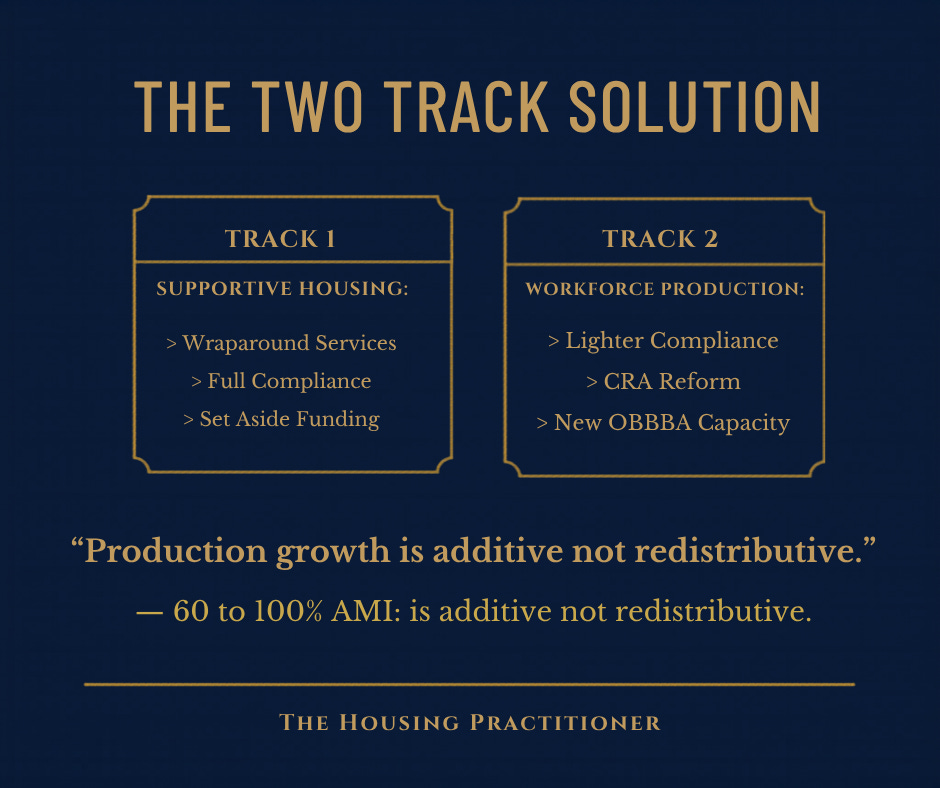
What a Second Track Looks Like
The OBBBA expanded credit allocations by 12%. New capacity. The question is whether it gets absorbed into the existing single track or whether it builds something different.
Create a dedicated workforce production pool within QAP allocation. Target 60 to 100% AMI households. Lighter compliance architecture. Fewer funding sources. Faster timelines. Lower transaction costs.
Protect the deep targeting pool that serves the populations advocacy coalitions represent. The 30% AMI households. The chronically homeless. The disabled. Those programs stay intact. Growth is additive, not redistributive.
That is how you get it done politically. Not by fighting over the existing pie. By making the pie bigger and dedicating the new slice to the workforce.
The Average Income Test created a statutory pathway to include workforce households within a LIHTC project. But investor appetite remains uneven. Blended compliance risk makes syndicators cautious about pricing these deals competitively. The AIT was a step. The two track system is the destination.
Pair it with CRA modernization that gives bank examiners enhanced weight for workforce targeted LIHTC investments. The equity pricing recovers. The deals pencil. Production scales.
The math exists. The financial architecture can be retuned. What it requires is the decision to stop asking one program to carry every load.
The ROAD Act vote proves the appetite for bipartisan housing legislation is real. The question is whether the conference committee designs around political narratives or financial architecture.
Practitioners know which one builds housing.
Next issue: The Hidden Engine. Banks provide 80% of LIHTC equity. What happens when CRA enforcement weakens and the deposits start to leave?
The 100 Year Pivot is available now on Amazon in paperback and Kindle.
https://a.co/d/0c3YEcol
David F. Petroni is the founder of DFP Enterprises, the author of The 100 Year Pivot, and a developer who has assembled tax credit transactions across 19 states. He also provides subsidy layering review and project based voucher structuring for developers navigating capital stack assembly. He writes The Housing Practitioner for practitioners who want analysis grounded in deal experience, not theory.
Subscribe to The Housing Practitioner for weekly analysis on workforce housing policy, LIHTC reform, and the financial architecture behind affordable housing.
Related from Regulation:
Working an affordable housing deal?
Get a Subsidy Layering Review | See All Services | Get in Touch