

I built the Practitioner Multiplier for myself first.
Two years into running production agent stacks across LIHTC, PBV, real estate finance, and consulting practices, I had the problem the work was supposed to solve. I was running out of time.
The tool stack was paid for and present. Master proforma in Excel. Application portals at the state housing agency, HUD, the local participating jurisdiction. Document management. Market study and comp databases. Brokerage CRM. The capability was on the books. The time was not.
The hours were going somewhere. They were disappearing into the gaps between the tools.
The LIHTC application due in 30 days, the proforma rebuilt from scratch in the agency’s QAP format because the master file did not project that way. The gap funding stack (HOME, AHP, state TC, sometimes CDBG) where each application asked for the same numbers in a different shape. The updated capital stack on a deal that had already cycled through 25 model versions, every change to equity pricing or rate walked by hand through sources and uses, cash flow, DSCR, returns. The closing checklist on a LIHTC partnership rebuilt one document at a time when it should have assembled itself from the deal type. The market evaluation typed by hand from CoStar, MLS, the county recorder, and the assessor into the deliverable. The brokerage listing kit assembled the same way on every engagement.
Does this sound familiar?
Each detour was rational at the individual step. The email to the partner accountant. The note to the syndicator. The cell hand keyed because the model output did not flow into the agency form. Across a year of files those moves cost me the kind of time I actually wanted. Dinner with friends. A day with family. Two weeks of travel without the laptop open the whole time. The room to write the next book.
The tools I was paying for were not running the practice. I was. And the practice was eating into my time.
The Practitioner Multiplier℠ is what I built to take that time back.
The category that misreads where the gap lives
A class of products has emerged that gets the diagnosis backward. They sell AI command centers, agent toolkits, prompt libraries. The pitch is more capability. The assumption: the practitioner is one capability away from the productive practice.
In a few cases that is true. In most cases the practitioner already has the capability. What is missing is the layer that makes the capability actually fire on the work in front of them. Adoption looks like a willpower problem. It is treated like an interface problem. It is, in fact, an architecture problem.
When the proforma does not translate to the agency’s tab structure, someone retypes it. When the gap funding application does not draw from the master deal file, someone rebuilds the underwriting from scratch. When the closing checklist does not assemble itself, the legal team and the developer chase eighty documents one email at a time. When the market evaluation does not pull comps on its own, the analyst copies cells from one window into another. Each detour is rational at the individual step. Across a year of files, the practice bleeds output, and the practitioner bleeds the hours of life that used to fund it.
The tools were never the constraint. The defaulting to manual was.
The Practitioner Multiplier℠
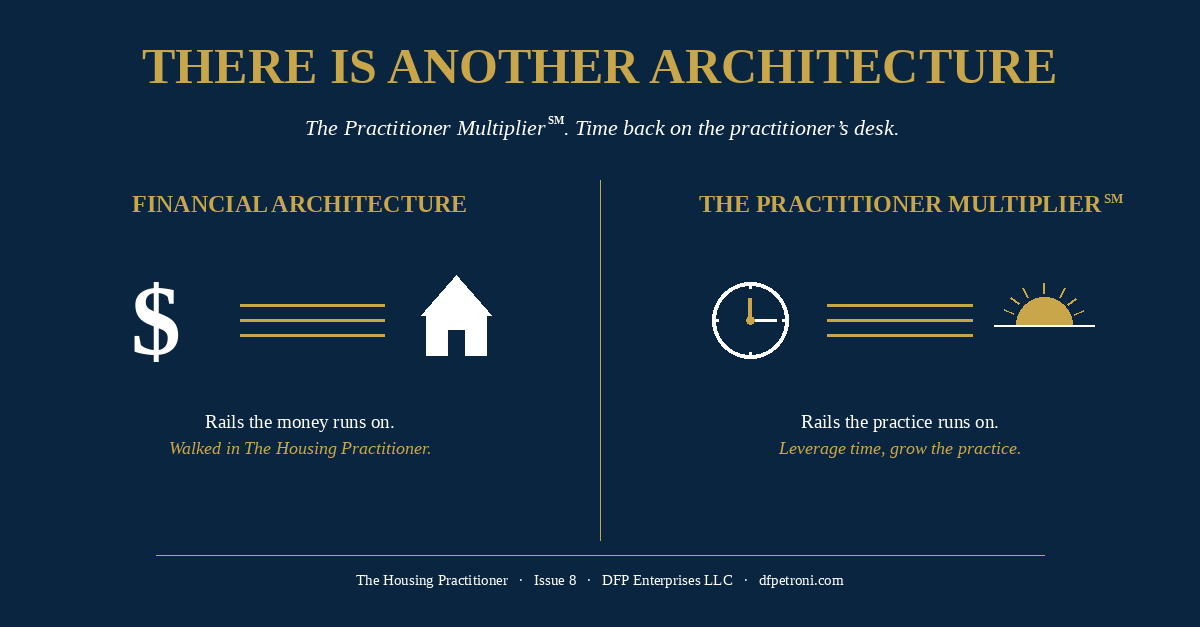
The Practitioner Multiplier℠ is the operating layer that sits above the practitioner’s existing stack and converts capability into recovered time. It does not add tools. It is built to make the tools already paid for fire the way they were always supposed to.
A few examples of the shape: the proforma update that propagates through every dependent view rather than getting walked by hand. The application that draws from the master deal file rather than getting rebuilt in the agency’s format. The market evaluation that begins assembling the moment the comp pull runs. The hours that used to live in the gaps between the tools come back to the practitioner’s calendar, available for the work that actually requires judgment.
The brand line: leverage time, grow the practice.
What the Practitioner Multiplier℠ is, and is not
The Practitioner Multiplier℠ is not a software platform. Not a chatbot. Not a packaged AI command center the practitioner logs into, learns, configures, and maintains. Those products relocate the adoption problem rather than solve it. The practice now has to adopt the command center on top of the stack already underused.
What it is: a methodology that runs on AI but is not sold as AI. It is the operating discipline that sits above the tool stack and decides what the tools do, so the practitioner does not have to. It has been developed and audited across four production practices. It crosses into almost any practice where the work is repeated and the time it costs is not recovered.
The next issues
This is the first issue. The ones that follow are not built to demonstrate the architecture. They are built around the stories practitioners send.
What does getting time back on your desk mean in your practice? The hour you stopped giving to rebuilding the same proforma in a different format. The Saturday with family you have not had in two years. The two weeks of travel the practice could not absorb. The room to write the paper you have been meaning to write.
Send the story. The next issues are the stories.
If this sounds familiar, let’s talk
Email: dpetroni@dfpetroni.com.
Conversation: https://calendly.com/dpetroni.
Site: https://dfpetroni.com
Tell me what time back means for you.
David F. Petroni is the founder of DFP Enterprises LLC and architect of The Practitioner Multiplier℠. He has operated in LIHTC, PBV, real estate, and housing finance consulting since 1989. He has built production agent stacks across those domains since 2024. He is also the author of The 100-Year Pivot.
Related from LIHTC:
Working an affordable housing deal?
Get a Subsidy Layering Review | See All Services | Get in Touch