

I am not a crypto expert. I spent 37 years building affordable housing. But something is happening with stablecoins and CRA that connects directly to whether workforce housing gets built, and more people need to understand it.
How Banks Fund Housing
Banks make money from your deposits. You put money in a savings account and earn maybe 1 percent. The bank lends that money out at 5 or 6 percent. The difference is the bank’s income. That income is taxable.
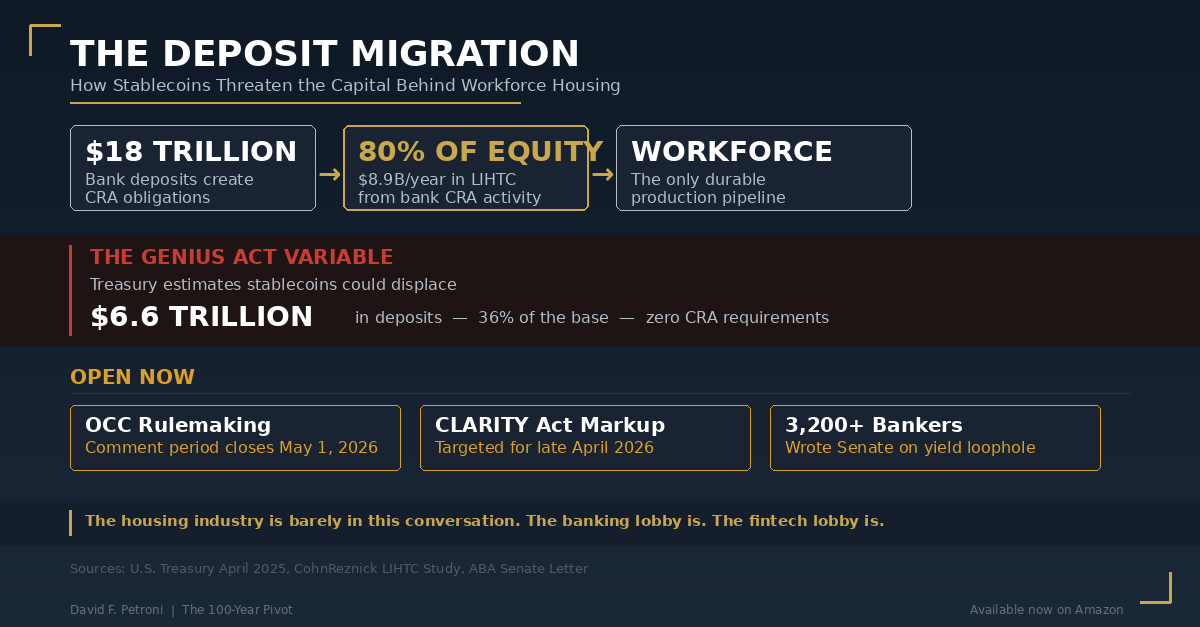
To reduce that tax bill, banks buy housing tax credits. A developer builds affordable housing. The bank buys the tax credits from that project and uses them to offset the taxes on the income they earned from your deposits. That is why about 80 percent of affordable housing equity in this country comes from banks. Roughly $8.9 billion a year. It is not charity. It is a business decision tied to deposits.
There is also a legal reason. In 1977, Congress passed the Community Reinvestment Act because banks were taking deposits from minority and low income neighborhoods and refusing to lend or invest back. Redlining. The CRA said: if you profit from a community’s deposits, you have an obligation to invest in that community. Housing tax credits became one of the best ways for banks to meet that obligation.
So two forces push bank capital toward housing. Taxable income they want to offset. And a legal obligation tied to the deposits they hold. Both depend on the same thing: money sitting in the bank.
The Double Hit: Stablecoins and CRA
Stablecoins are digital currencies pegged to the dollar. A place to park money outside of a traditional bank account. Last July, Congress passed the GENIUS Act giving stablecoins a federal regulatory framework for the first time.
If people move money from bank accounts into stablecoins, two things happen at the same time.
The bank loses deposits. Fewer deposits means fewer CRA obligations. The legal pressure to invest in communities shrinks.
The bank earns less income. Fewer deposits means a smaller lending base. A smaller lending base means less taxable income. Less taxable income means the bank needs fewer tax credits. The financial incentive to buy housing credits weakens.
The obligation shrinks. The incentive shrinks. Both at the same time. That is the double hit.
The Numbers
The Treasury Department estimated up to $6.6 trillion in deposits could be at risk of migrating to stablecoins. That is a stress scenario, not a certainty. It assumes high substitutability between traditional deposits and tokenized cash. But even a fraction of that number matters.
The Independent Community Bankers of America modeled a more immediate scenario: $1.3 trillion leaving community banks, reducing community lending by $850 billion. Community banks provide roughly 60 percent of small business loans and 80 percent of agricultural lending nationwide. That is not Wall Street money. That is Main Street money.
The stablecoin market already exceeds $281 billion in total capitalization as of March 2026. The GENIUS Act technically bans paying interest on stablecoins directly. But the yield loophole, allowing activity based rewards, is the contested provision that has 3,200 bankers writing the Senate. The American Bankers Association organized that letter in January.
The Federal Reserve published research on this dynamic in December 2025. The Progressive Policy Institute warned the impact falls hardest on rural and low income communities. The places with the fewest credit options to begin with.
The CRA Investor vs. the Yield Investor
We already see a version of this playing out inside the credit market itself.
Some banks buy housing tax credits because of CRA. They invest in communities where they hold deposits. They accept lower yields because the community reinvestment value justifies the pricing. When CRA enforcement is strong, these investors drive pricing up and deals get done. Current LIHTC equity pricing runs around 85 cents per tax credit dollar.
Other investors buy credits purely for yield. No community motivation. No deposit relationship. They behave like institutional buyers in the single family rental market, the build to rent operators who buy entire neighborhoods and manage them for cash flow. The parallel is not exact but the dynamic is the same. Capital without community obligation prices differently than capital with it.
Stablecoins accelerate the shift from the first kind of investor to the second. By shrinking the deposit base, they shrink both the CRA obligation and the taxable income that makes credits useful. What remains is yield only capital. And yield only capital does not build workforce housing in markets where the returns are thin.
In CRA markets today, LIHTC equity pricing holds steady. In CRA deserts, the rural areas and small cities without a critical mass of bank deposits, pricing falls. Stablecoin deposit migration widens that gap.
Who Is at the Table
The banking lobby is in this conversation. The fintech lobby is in it. The OCC comment period on stablecoin regulation closes May 1. The CLARITY Act markup is targeted for late April.
The people who actually build and finance affordable housing are not at the table.
Nobody in the housing industry is making this connection publicly. I searched. The stablecoin deposit conversation is happening in banking and fintech circles. The housing production side of the equation is absent. The Fed is publishing research. The ICBA is modeling losses. The Progressive Policy Institute is warning about rural communities. And the practitioners who assemble the capital stacks that produce the housing are silent.
The Critical Detail
Stablecoins carry zero community investment requirements. There is no CRA for crypto.
The 2023 CRA modernization rule that would have updated community investment standards for the digital era is currently stayed by a Texas district court injunction. It is expected to be scrapped. New rules have not been formulated.
So the regulatory framework that connects deposits to community investment is frozen. And a new financial product that moves deposits outside the banking system entirely now has a federal charter to operate at scale.
What I Am Asking
I do not know how fast this moves. The $6.6 trillion number is a ceiling, not a forecast. A fraction of that still damages the pipeline. The ICBA’s $1.3 trillion community bank estimate is closer to a near term risk.
I wrote about the CRA equity mechanics and the digital asset variable in The 100 Year Pivot, Chapters 9 and 10. Most practitioners I talk to have not mapped this yet.
The connection between deposit migration and housing production is structural. I would rather start the conversation now than after the pipeline is damaged.
What are you seeing in your market? Is the capital side shifting, or is this still theoretical where you sit?
Sources:
U.S. Treasury TBAC, April 2025 (deposit displacement estimates)
CohnReznick 2024 LIHTC Equity Market Volume Survey (bank share of equity)
ICBA Analysis, December 2025 (community bank deposit/lending impact)
Federal Reserve FEDS Note, December 2025 (stablecoin implications for deposits and credit)
Progressive Policy Institute, “Stablecoins Will Lessen Community Lending”
American Bankers Association, 3,200 banker letter, January 2026
OCC Notice of Proposed Rulemaking, March 2026 (comment period closes May 1)
Novogradac, June 2025 (LIHTC equity pricing data)
The 100 Year Pivot is available now on Amazon in paperback and Kindle.
David F. Petroni is the founder of DFP Enterprises, the author of The 100 Year Pivot, and a developer who has assembled tax credit transactions across 19 states. He also provides subsidy layering review and project based voucher structuring for developers navigating capital stack assembly. He writes The Housing Practitioner for practitioners who want analysis grounded in deal experience, not theory.
Subscribe to The Housing Practitioner for weekly analysis on workforce housing policy, LIHTC reform, and the financial architecture behind affordable housing.
Related from Regulation:
Working an affordable housing deal?
Get a Subsidy Layering Review | See All Services | Get in Touch