

Last time I introduced Next Generation Logic™ and promised a walk through the actual NGL Tools. Here it is, and I want to start with where this really came from, because it did not start as a product idea.
It started inside my own LIHTC business. Over the years I built out a full suite of internal tools, off the shelf, off any app, just spreadsheets and models and workflows I put together because I needed them, to get my own deals done faster and more accurately. NGL℠ Tools and Practitioner Multiplier℠ are what happened when I looked at that internal suite and realized it was not just saving me hours. It was creating something more valuable than the hours themselves. It was creating time, the one asset none of us can buy more of no matter how the deal goes.
That is the twist I have been sitting on for a while. I held off publishing this part because I wanted to perfect it further, either as a longer term enhancement to the app or, frankly, as its own separate product. Instead of talking about it in theory, I decided to apply it to something real first.
I recently got awarded two LIHTC deals in Ohio with terrific partners in the industry, and this time the process behind them was different. I built and directed AI agents to investigate, underwrite, and help prepare aspects of both applications, using them as a way to actually learn the scoring criteria, the funding challenges specific to each deal, and how to adjust the approach as market conditions shifted underneath us. I want to be careful about what I am and am not claiming here. The agents did not decide anything. I did, the same way I have for 38 years. What they did was compress a learning curve that would normally take me far longer to work through on my own, and hand me research and analysis I could then evaluate, correct, and act on.
I will also say plainly that the learning curve has not been simple. There have been moments where the agent got something wrong the same way a capable but inexperienced employee would, confidently, and in a way that needed a second set of eyes to catch. That is oddly reassuring today. It means the tool is not something beyond my judgment, it is something that still needs it. I am less certain that stays true forever, and I think being honest about that uncertainty matters more than pretending I have it all figured out.
I am treating these two deals as exactly what they are, a proving ground, not a finished victory lap. They are what I am using to decide where I take the end product from here, whether it gets deployed as a commercial tool at all, or whether the better use of it is simply continuing to give back to this industry as I believe some genuinely historic changes are headed our way. In the process, I also decided to apply pieces of this same tool set to the broader real estate industry, not just LIHTC, releasing parts of what I originally built for affordable housing deals into tools for the opportunities I evaluate, close, or work on every week. Different asset classes, same underlying question. What does it actually give me back? Time.
What NGL Tools Actually Look At in a LIHTC Deal
I want to give the industry a real sense of this without giving away the process itself. What I have built took more than a year of work to get right, and the specifics of how it functions are staying mine for now. But at a high level, here is the category of problems it is built to help a practitioner think through faster.
LIHTC scoring is a moving target. Every state housing finance agency runs its own Qualified Allocation Plan, and the point categories, set asides, and tiebreakers shift from cycle to cycle. Part of what I built helps a practitioner reason through how a given site and unit mix is likely to score under the current plan, before that practitioner commits months of soft costs to an application that was never competitive to begin with.
The capital stack is the other constant headache. A 9 percent or 4 percent LIHTC deal rarely stands on tax credits alone. It is credits plus soft debt plus a deferred developer fee plus, in a lot of Ohio deals, two or three more layers on top of that. Part of what I built helps think through how those pieces are likely to fit together and where a gap is probably going to show up, before it shows up at the closing table.
The last piece is timing and market conditions, which change constantly and which most practitioners are tracking by memory and gut feel because there has never been a good way to track it systematically. Part of what I built is aimed at keeping that picture current instead of stale.
That is as specific as I am going to get publicly for now. I am not trying to be coy about it. I am trying to protect more than a year of real work while still being honest with this industry about what is coming, because I do think what is coming is significant, and I would rather practitioners hear that from someone who has actually built something than from a vendor selling them a demo.
What I Am Not Building, and How NGL℠ Tools Actually Solves It
I want to be direct about what this is not. It is not a chatbot with a real estate skin on it. It does not replace the broker, the underwriter, or the analyst.

Here is specifically how it addresses the two problems I see most often. The first is hours lost to work that never needed a human hand on it. NGL℠ Tools solves that by handling only that category of work, pulling comps, running a valuation model, screening a listing against a buy box, and handing the output back to the practitioner rather than a finished decision. The second problem is offices treating AI adoption as a headcount conversation instead of a leverage conversation, cutting staff instead of multiplying what each person can do. NGL℠ Tools is built around the second framing on purpose. It is designed to let one practitioner carry more volume at the same quality, not to make the practitioner optional.

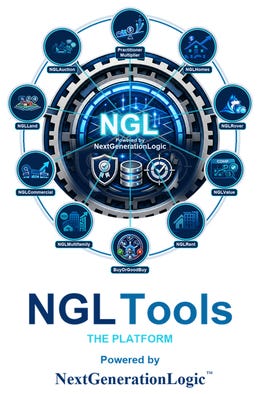
NGL℠ Tools is a suite, not a single app. Practitioner Multiplier℠ handles valuation and positioning. NGLHomes,℠ NGLMultifamily℠, NGLCommercial℠, and NGLLand℠ each pull comparables and market data for their property type. NGLRent℠ and NGLValue ℠ run pricing logic. BuyOrGoodBuy℠ screens a single family deal against your criteria and gives you a straight answer. NGLAuction℠ and NGLRover℠ cover foreclosure and off market sourcing.

Each tool does one job well instead of one model trying to do everything passably. That is the difference between a general purpose chatbot and a practitioner tool. A chatbot answers whatever you ask. A practitioner tool is built around the specific questions the job actually requires, day after day, deal after deal.
Time Saved, and Why This Is Not Optional Anymore
I want this part to be honest instead of just reassuring.
AI is here. It is not a trend that passes. The practitioners who find a way to use it well are going to outpace the ones who wait it out, the same way agents who learned the MLS outpaced the ones who kept working off paper listings. Fox Homes put it plainly in their 2026 outlook: agents who avoid AI are not protecting themselves, they are falling further behind, while AI makes average agents easier to replace and strong agents more valuable. That is not a hope on my part. It is where the data points.

Becoming a more effective practitioner is one real way to stay relevant, and there is research behind that, not just my opinion. One 2026 industry analysis found an agent who handled twenty clients a year could reasonably handle forty with the same time investment, provided they still master the parts AI cannot do. That is the trade this whole approach is built around. The tool gives you the volume. You still have to bring the judgment.
And here is the part that matters most, because I know this is where people get nervous. AI cannot replace us yet, and the people closest to this problem keep saying so on the record. Chris Atwell, the 2026 president of the Orlando Regional REALTORS Association, has said plainly that AI cannot replace the human judgment, earned trust, and advocacy a real practitioner brings to a transaction. Lee Davenport, who studies this professionally, put it even more directly: not yet, and maybe not ever, not because the technology is not improving, but because judgment in an ambiguous, high stakes decision is not something a model can carry on its own. I do not know how long that stays true. Nobody does. But it is true right now, and it is exactly the gap NGL℠ Tools is built to work inside of, not around.

I did not build this to cut people out. I built it because bad process was cutting into my life, and I suspect it is cutting into a lot of other practitioners’ lives too. An office that was already carrying dead weight in the form of manual, repetitive analysis work is going to feel this shift. An office where every person is doing work that actually requires their judgment is going to feel this as relief, not threat. I built NGL℠ Tools for the second kind of office, and to help offices become that kind of office.
Most AI real estate tools on the market today are a general model with a real estate prompt wrapped around it. Ask it a question, it searches its training data and gives you an answer that sounds confident whether or not it fits your submarket. That is fine for a first pass. It is not fine for a closing.
I built NGL℠ Tools the other way. The logic underneath each module comes from decades of my own pattern recognition in the field, not from a language model guessing what a good answer probably looks like. When Buy Or GoodBye screens a single family home flippers deal, it is applying rules I would apply. When Practitioner Multiplier℠ runs a valuation, it is running the same positioning logic I have used for decades, just faster than I could do it by hand. The AI in the background handles retrieval and speed. The judgment came from the field, not from the model.
That is Next Generation Logic™ in practice. The technology accelerates execution. The practitioner still owns the thinking, and this time the thinking the tool is built from is mine.
What Comes Next
The two Ohio awards are still early proof, not a finished case study, and I will keep testing before I call any of this done.
I am still working through the rebuild scope on the mobile side before this reaches the App Store, and I will keep testing it against real deals before I call it finished. But the direction is set. I am not trying to replace the people who do this work. I am trying to make sure the people who do this work, myself included, spend their time on the parts only they can do, and get some of that time back for the rest of their life.
That is the whole idea behind Next Generation Logic™, and it is the same idea that ran through The 100-Year Pivot from the first page. The technology changes. The judgment that makes it useful does not.
David Petroni is the owner of DFP Enterprises and author of The 100-Year Pivot. He has 38 years of experience in affordable housing development across 19 states.
Get the book: The 100-Year Pivot | Connect on LinkedIn | Subscribe on Substack
NGL℠, NGL Tools℠, Next Generation Logic™, Practitioner Multiplier℠, NGLHomes℠, NGLMultifamily℠, NGLCommercial℠, NGLLand℠, NGLRent℠, NGLValue℠, NGLAuction℠, and NGLRover℠ are trademarks of DFP Enterprises.