

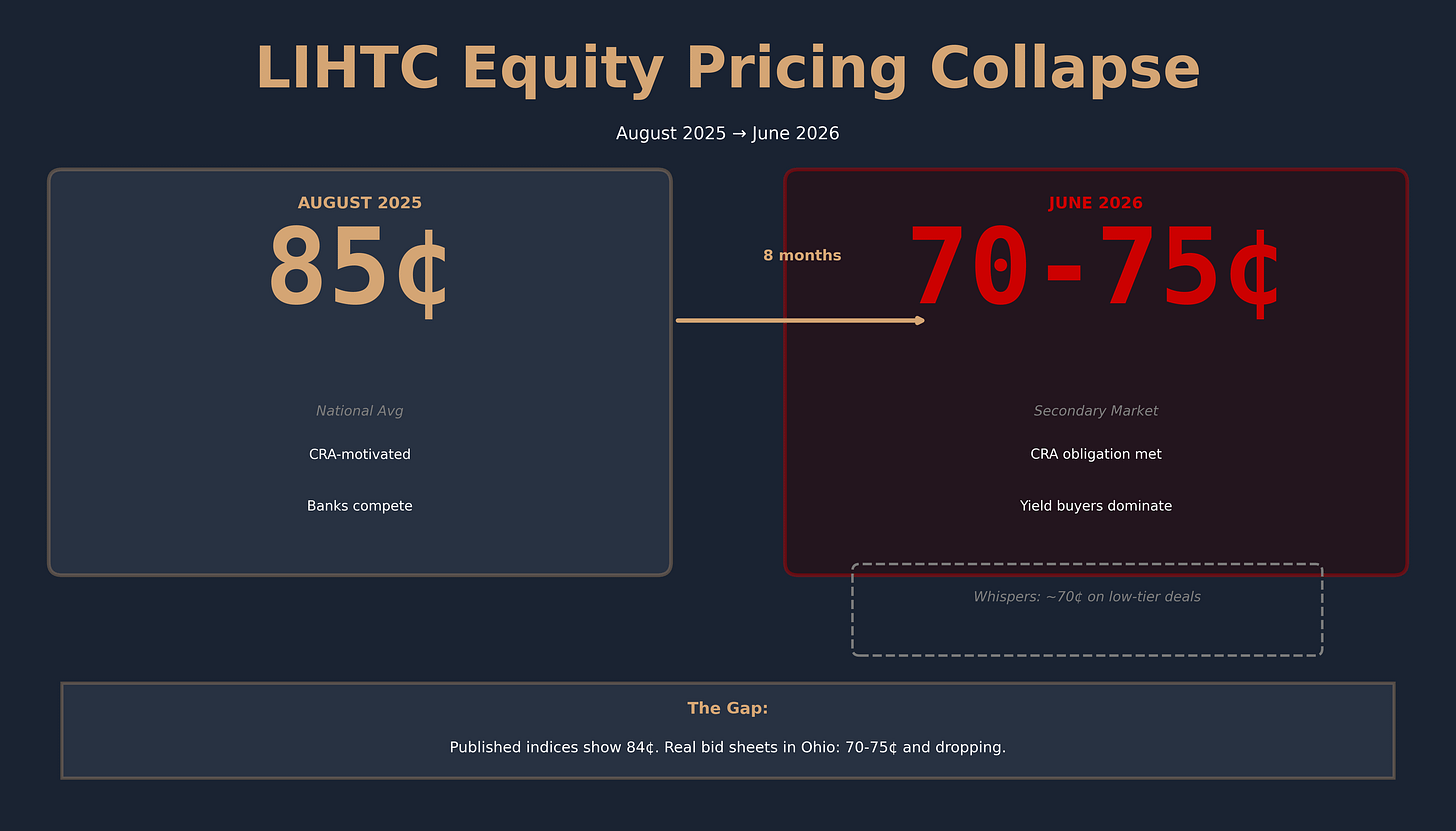
What if your deal just quoted 75 cents in a Midwest market. Just last August that deal would have been in the mid 80s. I am pricing two LIHTC submissions in Ohio and this is exactly where the market sits right now. Not everywhere. Not all deals. But in the secondary markets where I work it is the new standard.
Where LIHTC Equity Pricing Actually Sits
The published averages still show national LIHTC equity pricing hovering around 84 cents per credit dollar. Novoco tracks that number quarter by quarter. But the bid sheets coming in today on real submissions are lower. The gap between what the indices report and what the market is actually pricing is getting wider. The whispers are in the low to mid 70s. Not yet the published number. But showing up on the LOIs more frequently.
Here is what I think changed. The banks funding the equity said we have hit our CRA goals. They satisfied their mandatory obligation to community banking. They deployed the minimum capital the regulators required. Mission accomplished. Obligation met. So now they are deploying remaining capital as pure yield investors. No CRA subsidy. No mission alignment. Just return.
But here is the question that keeps me up. Are ALL the program investors doing this. Not just the banks. Are the foundations moving to market return. Are the syndicators becoming economic players. Are the regional players shifting stance. If the answer is yes then we have a supply problem that pricing cannot solve. We have exhausted mission capital. Everything left is economic capital. And economic capital will not price workforce housing.
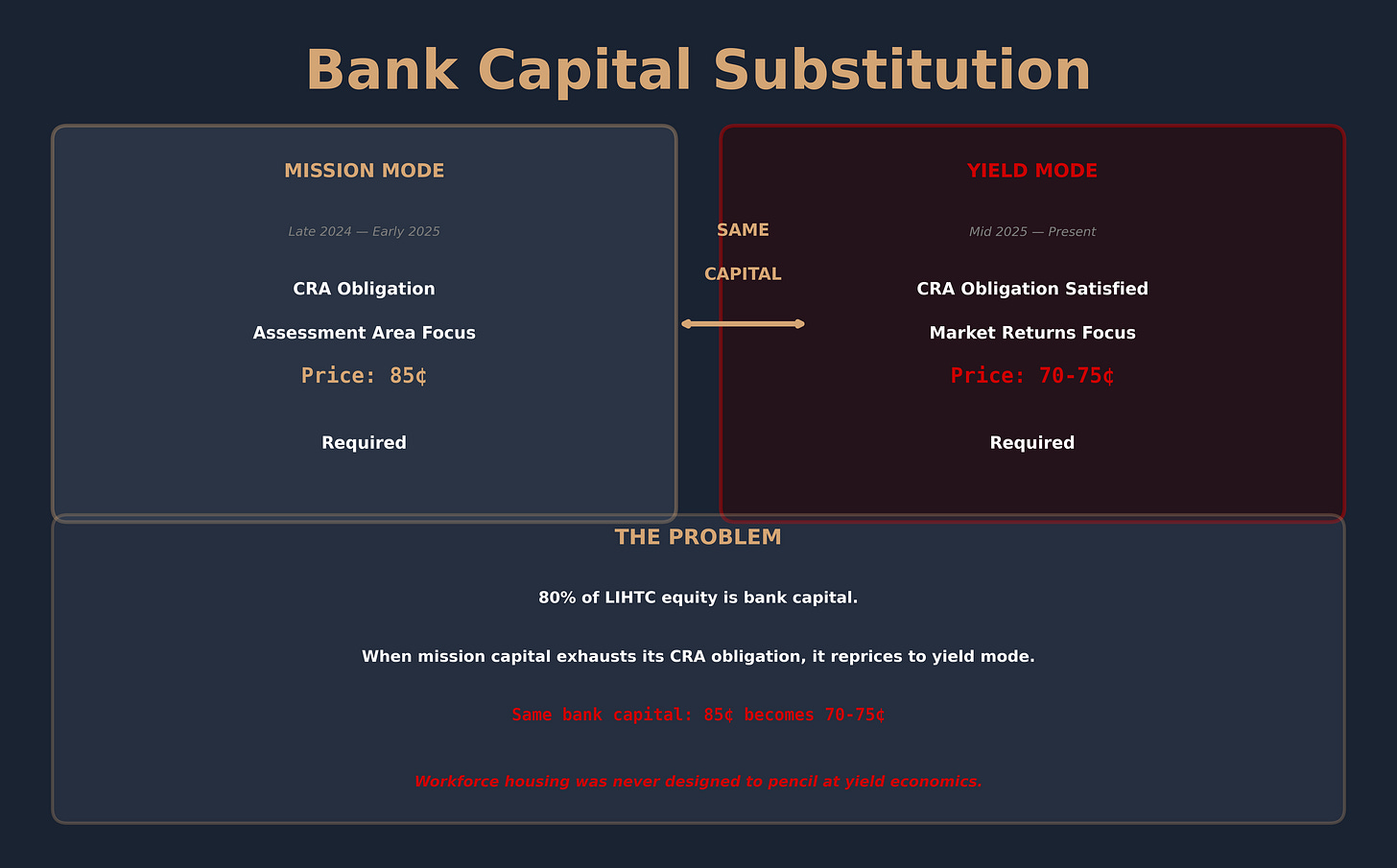
Workforce housing was never designed to pencil at yield buyer economics. It was designed to pencil because a bank would accept lower return. Lower return as the cost of staying compliant with Community Reinvestment Act requirements. Investing in your own backyard. Mission plus return. That was the construction that made 85 cent pricing make sense.
When the same capital shifts from mission pricing to yield pricing the deal breaks. But what happens when ALL the capital shifts. What happens when there is no mission capital left. Yield buyers compete on return. Your deal has to hit a higher number to get their attention. So 75 cents becomes the market price. Maybe upper 70s if you build it right. But that is the floor.
The national picture shows this is not regional. It is structural. Secondary markets are seeing greater pricing compression than primary markets. California, Texas, New York. Those coastal states still have alternative capital sources. State housing finance agencies. Policy banks. Foundation capital pools. Syndicators with deep capital. But even in those markets the trend is the same. Mission capital is tightening. Economic capital is rising.
The OBBBA expansion increased the total supply of LIHTC credits effective 2026. Developers can access larger allocations. But thinner equity proceeds. The credits are diluted. More supply of credits means lower price per credit. That is basic economics. For developers everywhere that means the capital stack got wider and the equity got thinner at the same time.
But the deeper supply demand question is this. If program investors are systematically becoming economic not mission motivated then the program has a structural problem. Supply of credits increased. Demand for mission capital decreased. The intersection point is lower pricing. But pricing is not the real issue. The real issue is whether there is ANY capital left that will work at the economics of workforce housing.
Congress is talking WHTC and BTR. The Workforce Housing Tax Credit came back. Build to Rent legislation is advancing. I understand the intent. I support the policy direction. But neither puts capital back into deals at mission pricing. Neither solves the core problem. You cannot legislate a bank back into a credit obligation they have already satisfied. You cannot tax credit your way back to the capital quality you lost.
The conversation everyone is missing is about CRA obligations themselves. Whether they are sized right. Whether they are enforced right. Whether they are big enough to keep banks deployed at scale even after they hit their quota. With 80 percent of national LIHTC equity made by banks, and a large percentage of that now economic not mission driven, we have a capital quality crisis.
I document this capital substitution cycle in The 100-Year Pivot. The book traces how bank credit obligations drove higher equity pricing in the past and why the loss of that obligation pressure creates this shift. The mechanism is economic, not moral. The banks are not bad actors. They are responding to incentives. When the incentive changes the capital moves. That is exactly what we are watching. But when all the capital responds the same way we have an industry problem.
So here is the question that matters. If program investors are all becoming economic are we at the point where the industry needs to rally. Are we at the moment where practitioners say this is a structural problem we have to fix together. Is it time to push back on policy. Is it time to demand CRA enforcement that actually keeps capital at mission scale. Is it time to admit that workforce housing cannot pencil at 75 cents and ask what the actual answer is.
I do not have the answer. But I know the question. If not now, when. If all the capital becomes economic, how do deals get done. That is the conversation we need to have.
Send me what you are seeing. Are program investors becoming economic across the board. Are there pockets of mission capital still deployed. What is the actual supply of mission capital left in the market. What does it take to keep a bank at mission pricing after they satisfy their CRA obligation. What regulatory or structural change would unlock that.
The next article needs your voice in it. The industry needs to know if this is a moment to act.
Working an affordable housing deal?
Get a Subsidy Layering Review | See All Services | Get in Touch